I would have done Welsh, but I couldn’t remember where it is. I didn’t quite know where Berry was, either, but I managed to find it, as I knew it was off Josephine. Aside from feeling horrible on the hills themselves, I felt good, and would have liked to do Welsh (or another hill) just to do six. The roads were wet in spots, and I spun my rear wheel on both Logan and Sycamore.
So a certain Texan is going to return to PRO cycling. Bully for him. He wants to win another Tour de France, ostensibly for cancer research, but more likely because he’s watched a handful of riders who he routinely crushed win in his absence. I don’t have particularly strong feelings about Armstrong. Maybe he doped, maybe he didn’t. Yes, he was a great rider in the Tour de France. But I am much more impressed with Greg Lemond’s palmares–top five finishes in the Spring Classics, podium finishes at the Giro d’Italia (the same year he won the Tour!), and two world championships. But Armstrong came of age in an era of specialists (beginning with Indurain–though, in his defense, he took two Giro/Tour doubles), and he was the greatest among them.
The fuss now is for whom Armstrong will ride. Astana, led by his favored DS Johan Bruyneel, is a popular choice. But this is problematic. First, Astana was excluded from the Tour this year (because of past indiscretions) and is no lock to receive an invitation next season. Second, Astana is already loaded, with Alberto Contador (he of the recent “triple crown” of Tour, Vuelta, and Giro wins) and two other Grand Tour podium winners, Levi Leipheimer and Andreas Kloden. Kloden seems to have accepted his fate as a super domestique, but Levi is clearly not content winning North American stage races. He pushed hard in the Vuelta to take second place, and took back a fair chunk of time in the final time trial, to finish only 40 seconds back. Contador wasn’t pleased:
Contador also had some pointed remarks about teammate Levi Leipheimer, who finished 46 seconds back in second place.
“I will only say that it’s not normal that someone that is supposed to be working for you finishes less than one minute back in the GC,” Contador said. “If Navacerrada had been 20km more, I don’t know what would have happened.”
Two things worth noting here:
1. It seems like Levi may be racing elsewhere next season.
2. Contador is tacitly admitting he wasn’t the strongest on the team, simply the chosen leader.
What’s more, it appears that Contador would fly, too, if Astana took Armstrong:
“It would be quite complicated. I think I’ve earned the right to be the leader of a team without having to fight for it,” he said in the interview published Tuesday. “And with Armstrong, there could be difficult situations in which the team would put him first and that would harm me.”
I’d like to see one of two things come of all this:
1. Bruyneel gets Armstrong, then tells the quartet that the team will deliver them, with the peleton appropriately shredded, to the base of every major climb. From there, they can sort out who’s the best.
2. Leipheimer goes to CSC (who is without a true GC threat without Sastre–and give Schleck the Younger a few more years). Armstrong goes to Astana. Contador goes to a team that will worship him.
No doubt that Contador doesn’t want Armstrong to rain his reign as the new stage race patron. I can’t imagine Levi sticking with Astana in any situation. Contador likely believes he can win all three Grand Tours next year, and that leaves Levi to win the Tour of California (or, maybe not, since Lance wants to race there) or the Tour of Missouri. He is obviously fit enough to challenge for a win, but he won’t get that chance at Astana, especially if Armstrong returns.
Any which way this all shakes out, it will make for interesting (and entertaining) reading for the next few months.
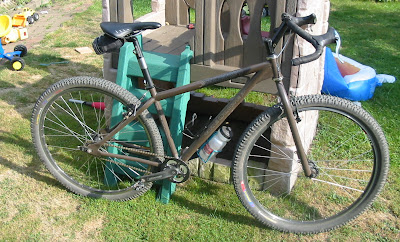
I installed the Origin8 flared drops on the Redline (since I purchased a set of Tektro levers that would work with the V-brakes) today. There it is. Note the various other high tech bits:
Awesome high rise steel stem. I await the day the shonky weld breaks and I pull a George Hincapie in the middle of Iron Grate at Frick.
The wrench for the rear wheel duct taped to the seatpost.
The safety pin holding the saddle bag together.
The shakedown went well. I started by tooling around a bit on the flatter bits of single track, then climbed up to the Blue Slide park/Meadows and went down Iron Grate. It took but a moment to get used to handling the bike in the drops. In fact, within a few minutes, the bike seemed to handle better with the drops–perhaps because I was a bit lower when in the drops, or perhaps because I felt like I could really drive the front end a bit more because of my hand position. Braking was easy, as the Tektro levers are comfy and didn’t require more than a finger to lock the wheel. The only things that felt a bit odd were getting the front end over big obstacles and getting a bit of air on a few of the bumps. Better to keep the bike on the ground, methinks. At one point, coming down Iron Grate, my rear wheel hit a rock and a root in quick succession, and I cannot believe that I didn’t flat or, given the noise, completely bust the rear wheel. Let’s hear it for high volume tires. There are also a number of ticks being emitted from various areas of the bike–the front end sounds like the wheel is completely loose in the fork when I go over anything, and something (saddle rails, maybe) was clicking. The chain sounds horrible, too. Given the nice surface coating of rust, I think I should probably replace it sooner rather than later.
I have a few more changes I’d like to make to Redline, too. Ideally, I’ll get some mechanical discs, if only because those V-brakes has been thoroughly abused. I’d also like to futz with the gearing a bit more, perhaps downsize the freewheel to 18 teeth, and get a 16 teeth TomiCog for cruising to the park. Spinning 32×20 on city streets is kinda silly.
The last race at the Oval was canceled due to a lack of riders. I will say the crowd that gathered put us right on the cusp, numbers-wise, but honestly, I’m glad we didn’t race. The group included the full spectrum of abilities, and I sensed that as it was, the race might be a bit on the slow side, and not terribly interesting. On the bright side, the road racing season ended on a high note with a good finish at Strongland.
As I’ve mentioned before, it’s hard to see this season as anything but a success. I progressed from a punter who was lucky to stay in the group for a few laps, to a rider who could sit in and maybe score a top ten finish, to someone who was active during the race at the front. Certainly I would have liked to score more points during the season, but seven was seven more than I thought I’d score. And even more surprising, I’ve been invited to join a team for next season (this is crazy). Steel City Endurance will be fielding a men’s squad, and I’m one of three or four riders picked from the C race. This should make season a bit more interesting, and fun, given that there were only two or three teams (at most) in any given C race, so there was very little in the way of tactics.
As for next season, the biggest goal is performing better outside of the Oval. Strongland was a good start, but the competition wasn’t as hard as, say, Mingo Creek. I’d like to be able to walk away from Mingo or Fort Cherry with a top fifteen finish. I don’t really have much of a training plan, besides “ride lots,” so we’ll see where that gets me.
Today was the Tour de Strongland road race. I waffled a bit about what race to enter–it’s a citizen’s race, not sanctioned by the USAC, so the categories were not the typical category 4/5, 1/2/3. After speaking with a few people, I decided that the 20 mile, intermediate road race, would be the best fit. I’m sure I could have done the expert race, but given who was likely to show up, I would get shelled pretty quickly. Perfect day for a race–temps just around 70, partly sunny. It was, however, quite breezy. The course is hillier than most Western Pennsylvanian road races, with several short climbs, and at least one long, gentle rise. My hope going in was to stick with the group through the first climb and see how things shook out.
Learning my mistake in the Fort Cherry race (well, the first mistake), I was sure to be at the front of the start grid. I saw a few other faces from the C races at the Oval, so I felt like my race choice was spot on. The start was neutral, but there was some confusion as to when the neutral section was over. We lollygagged for a bit once on the road, and once the pace car put some distance on us, we decided the race was on. The front of the group sorted itself out quickly, and worked fairly well. A fair number of people seemed to be willing to work at the front, and it was pretty rare when you pulled off that the group would just follow you. After a tight right hand turn, we approached the first climb.
Hanging on wasn’t an issue, and about a quarter of the way up, I moved to the front. I was working fairly hard, but was willing to write this off since it was the first climb. Once at the top, I peeled off and we hit a section of rollers. I wasn’t aware of it at the time, but apparently our pace up the climb shelled most of the group, leaving us with a group of eleven. This is how it would stay for the most of the race. Quickly, we were on the descent on Markle Road. This road is steep and windy, and it split the group a bit. Somehow, I managed to stay near the front. Quickly, we turned on Pine Road, and entered the longest bit of flat riding. The pace was still reasonably high, but not high enough to shell anyone. I spent my time at the front, but given the direction of the wind, staying in the group only offered a bit of protection.
Once off Pine and on Seventh Street Road, we hit the long climb. It wasn’t at all steep, just long. I sat near the back for a bit, and watched two riders take off. I began to move up, and promptly found myself at the front, and gaining on the two. A look back showed I had managed to gap the main group a bit. I kept pushing, and pulled through with the escapees. We continued to push to the top, and through a bit of flat. We turned on Manchester Hill Road, and went down, down, down. One rider gapped me a bit, and I couldn’t close it. At all. I was surprised, however, that no one passed me. The rollers on Millgantown Road brought the whole group back together, and for the most part, the pace stayed high. One rider pulled next to me and suggested I go with him on the big climb on SR56. I nodded, and waited.
Once on SR56, I was near the back of the group, and couldn’t really react when he took off. Oops. I sat in for a bit, and Mike from the Oval took off to catch him. I sat in a bit longer, then closed the gap to Mike, bringing most of the group with me. I sat in for a bit, then moved on to catch the escapee, unfortunately bringing everyone with me. One thing I realized on 56–I would need a HUGE gap to manage to keep away, because despite putting some distance between myself and the group on the climbs, they were quickly closing the gaps on the descents. On another rise, I moved to the front and tried to pin it a bit, and again got a bit of distance. A few riders bridged, and I stood up and gapped them again. We hit the top and, hey imagine that, I was passed. I did notice, however, that I manage to shatter the group a bit, and we were whittled down to maybe 8 riders. Once on the flats, the pass stayed high, and I was content to sit in, knowing there was one more climb before the finish.
Mike pulled through to start the climb, and popped a bit, so I moved up and pushed the pace. There was a surge from the back, though, and three riders passed me near the top. I caught and wheel and stayed with them, and the pace went really high as we approached the finish, a sharp left hander to the line. At this point, I had written off my chances for a win (way to think positively!), but wanted to stay in the top five. The pace slowed a bit just before the corner, and in retrospect, given the short straight to the finish, I should have tried to go here. I went into the corner in sixth, and managed to pass two riders for fourth. Woo.
I don’t think I could have asked for a better race. The group worked well together, I did a fair amount of work on the climbs, and finished in the top five. The course was very nice, and the race was well run. No complaints at all.
Sebastien took second place in the 4 and 5 year old race. Oren was a DNS in his race due to diaper-related issues.
I have precious little to say about the upcoming elections, and I am not a supporter of Ron Paul, but I can very much appreciate what Bill Kauffman has to say.
One week ago, I picked up a Novara Fusion on close-out at the local REI. $550, over two hundred dollars off, thanks to a clearance sale and the fact it was a returned model with a missing bulb in one of the headlights (more on this later). With the sale of the Steamroller and a bit of contract work, I didn’t pay anything out of pocket for the bike. Good deal. I considered a Transfer (another Novara city bike, with 559mm wheels and linear pull brakes), but the model REI had was bought before I could claim it. I also considered a Safari, but it was more than the Fusion, and I would still need to get fenders, at least.
The bike is an XL, 20 inches. A large would probably fit a bit better, but I have enough clearance, and the top tube is still a reasonable length so I’m not bent over. There’s a bit more than a fist full of seatpost showing, so as far as I’m concerned, the fit is fine. The bike looks big, but doesn’t feel big when I’m on it. The bike is, however, most certainly heavy. Listed at 35 pounds, I won’t dispute it. Given that it has a Nexus 8 speed hub in the rear, a Nexus generator hub in front, plus roller brakes and a rack, the weight is expected. The frame is a bit odd, too, with flared tubes and big, fat welds. It looks more racy than my racing bike.
I took the bike for a brief spin on Saturday night around the neighborhood. It was quite comfortable, and didn’t feel terribly heavy on the flat roads. The front light (dual LEDs, though mine only has one) is very much a “be seen” light. I have a Lumotec Oval Plus on the workbench, however, so I will swap this out as soon as I find the time. The Nexus hub shifted well, and even with the 46 tooth chainring, the gearing felt adequate. The Jitensha-style bars are comfortable (and better looking than the MASSIVE bars on the Transfer.
Baggage would be carried in a Delta waterproof pannier and an Ortlieb Bike Shopper pannier, which would carry my Pelican laptop case. Typical commute loads average about 10-15 pounds. Once loaded, the bike still felt good (and missing was the excessive wobble of the Steamroller). The ride to the office is mostly flat, with a single, short-ish, descent. The bike was predictable, and handled well, even loaded. I can’t say I noticed the weight, given that I rode a fixed gear with 42×19 gearing, and a load over the front wheel. If anything, the bike felt a bit easier, owing to the gears. The ride home includes a short, though not-insignificant, climb. I’ve found that I can downshift and spin up the hill, or climb out of the saddle without much trouble. Yes, the bike feels sluggish, but it’s not horrible. The Nexus hub shifts well under load, and doesn’t require that I stop pedaling (a nice feature when I’m mid-climb).
Much has been made about the stock gearing, which includes a 46 tooth chainring. For city riding, even around hilly Pittsburgh, it seems sufficient. Perhaps a 42 tooth ring might make the bike a bit more user-friendly, however. I also suspect that if you have a terribly hilly ride, and you have to carry heavy loads, this isn’t the best bike for you anyway.
The Nexus hubs include roller brakes. I was initially dubious about these, if only because of concern about product life. Several people have reassured me that the brakes do well in the wet and muck, and I’ve found their performance to be perfectly acceptable. Getting the cable disconnected (to remove the wheel) is a bit tricky, and requires reducing cable tension at the lever. I was happy to have the brakes during a rain shower, as there is no fade due to wet pads and rims. I also had some concerns about being able to use the hitch on our Burley trailer because of the cable attachment for the rear wheel. These concerns were unfounded, though, as there’s just enough room in the rear triangle for the hitch.
So what do I like? Well, the whole package. It’s a comfortable bike to ride, predictable even when loaded. The Nexus hub shifts well. The cockpit is comfortable and good looking. The rear rack is well-built. The tires (32mm Vittoria Randonneurs) are tough and comfortable. The fenders are sufficient–though I’ll probably add a proper mudflap)–and I reckon I might be able to fit studded tires in there for the winter. What don’t I like? Well, the stock saddle and suspended seatpost were almost immediately replaced. The pedals lack grip, too, and will soon be replaced with BMX models from the parts bin. The frame itself is odd–it’s too racy looking for the purpose of the bike, but I’m over that. The neon green paint job isn’t as subtle as the Surly, but again, it’s not a deal breaking for a bike that was purchased to be abused. The front light is also a bit sub-standard, but again, with a Lumotec Oval Plus on the work bench, I’m not concerned.
I’m not sure I would have paid full price for this bike (preferring, perhaps, the Transfer at full price), but for $550, I like it a lot. I suppose, too, for $799 (or whatever list was), it’s still a good deal. I’ll be curious to see how the hubs and brakes withstand the winter. I wouldn’t be surprised if they don’t make to it the spring (at least the front hub), but if the roller brakes and rear hub survive, I’ll be quite happy.