Ryan Anderson, writing at First Things, wonders if Bono, with his (RED) campaign, hasn’t drowned out the very voices he is trying to help. Bono’s campaigns rarely ask individuals to sacrifice much of anything (in fact, the (RED) campaign advocates more consumerism)–we simply attempt to have other shoulder the financial sacrifices (whether it be Congress, as with his ONE campaign, or trendy retailers with (RED)). Anderson wonders:
What a bizarre method. Why not appeal to our consciences directly and ask every American to donate 1 percent of our personal budget to the poverty-fighting charity of our choice? The ONE Campaign made significant inroads with the religious communities—having them demand more from the government. Why not ask for a tithe? Why not call for personal contributions instead of political noise-making?
But that would require sacrifice. And that wouldn’t sell. Nor would it be trendy. It’s so much easier to say we can fight AIDS by buying Armani and Gap. It’s so much easier to say we’ll end world poverty by telling Congress to do something about it. My “good-looking” “fine self” sleeps so much better at night knowing that my (RED) purchase has bought pills for someone in Africa, that my signature on the ONE declaration means I’ve done my part.
Additionally, Anderson notes that $2.3 trillion in Western aid has made but a tiny dent in the problems in Africa. Money is not the answer–an environment that foster individual and community development is. Anderson notes that a free market economy would do wonders for ailing African nations, and lest you think he is simply walking the Classical Liberal line, he quotes Pope John Paul II, no friend of unfettered capitalism:
It is also necessary to help these needy people to acquire expertise, to enter the circle of exchange, and to develop their skills in order to make the best use of their capacities and resources. Even prior to the logic of a fair exchange of goods and the forms of justice appropriate to it, there exists something which is due to man because he is man, by reason of his lofty dignity. Inseparable from that required “something” is the possibility to survive and, at the same time, to make an active contribution to the common good of humanity.
Anderson’s conclusion is proper: “In many cases there is no “real solution,” but only a response: love.” Bill Kauffman would agree. We can’t expect to help anyone by simply wearing a bracelet or buying a pair of jeans. The sacrifice is ours to make.
Posted on 13 March 2007
Those watchdogs of our civil liberties, the folks who bring you BoingBoing, point out this Austin café which has prohibited the use of laptops. Cory Doctorow takes us down the slippery slope to an Orwellian nightmare where we will not even be able speak will eating in a restaurant. If we do not stand up against these facists now, who knows where they will stop.
Indeed.
Some time ago, I wrote about a coffeehouse that decided to turn off its free wireless internet on the weekends in an effort to take back the space from students and professionals who sat hunched over laptops. The move was about restoring a sense of the shop being a Third Place (where people could gather and interact) and not about curtailing freedoms. And it is similar motivations that drive the restaurant in Austin, I suspect. Doctorow, living in his bizarre Leftist/Libertarian world, seems to believe that we have freedoms and that these freedoms are being stripped by the over-eager business owners. The first, glaring, problem is that the restaurant is a private business, and since there is nothing specifically in the Bill of Rights that confers to us the liberty to use our laptops wherever we please, that business has the right to set rules regarding its use. Second, Doctorow misses that might be the reason for the rule–that customers may have tired of listening to the tap-tap-tap of a keyboard while trying to enjoy a meal. Perhaps the owners were willing to tolerate some laptop use, but slowly, too many customers were tapping away. As with most limits on public behavior, this likely was born out of abuse.
It should also be said that Jacques Ellul is spinning in his grave thanks to this (non-) story. Ellul spent his life trying to explain that technology (Technique, to use his term) is, despite our best intentions, an autonomous force. Despite our attempts to mold and control it, Technique ultimately shapes and molds us. And here is Cory Doctorow, poster boy for Technique, fighting for our right to allow technology to encroach even further into our lives.
Posted on 13 March 2007
A friend gave me a copy of Jacques Ellul’s Perspectives on Our Age and tried to give me a copy of Bill Kauffman’s Look Homeward, America. While in many ways the books’ subject matters are far apart, in another sense they are quite closely intertwined. Both Ellul and Kauffman are committed localists, preferring the joys and sorrows of their particular places. Ellul, ever the sociologist, frames his perspective in this way:
I do not believe in global actions. I do not believe in actions on the level of the president of the Republic. In fact, I always apply the motto: “Think globally, act locally.” And this corresponds to what I have tried to be. By thinking globally I can analyze all phenomena, but when it comes to acting, it can only be local and on a grassroots level if it is to be honest, realistic, and authentic.
Kauffman would likely agree. In the most recent print edition of Comment, I tangled with Dr. David Koyzis over this very issue. I can’t agree more. While I have certain sympathies for organizations like the International Justice Mission and the political bent of many Neocalvinists, I also wonder what these folks could do in their own hometowns. We’ve started to talk about how we can embrace this ethic, in our neighborhood and in our church.
That said, I’ve discovered a paradox between this way of thinking and the realities of my chosen profession. I had decided months ago that my current employer was OK as far as these things went. The company was small, the product was acceptable (though after reading Illich on the medical profession, I had second thoughts), and the office was close enough to our home. Then, the office was moved to Sewickley, roughly a 40 mile round trip commute. I’ve been riding there twice a week, meaning nearly three hours on the bike those days. This time expense was not worth it (the ride, too, is fairly miserable, travelling as it does through Pittsburgh’s western industrial decay).
This is simply a long-winded way of saying I’m moving on. The decision was at once easy and quite hard. Easy, because there is little good about a three hour commute, even it is by bike. I generally only spend seven and half hours in the office those days, and I barely I have time to see my kids before they go to bed. Hard, because I’ve been given flexibility in my working arrangements. I poked around the market a bit and managed to get an interview. The company, located in the South Side, brought me in twice. The second interview was very technical in nature, and upon leaving I thought “well, there goes that opportunity.” Imagine my surprise a week later when I was given an offer I could hardly refuse. After, in turn, interviewing the company myself, and speaking with Jen about the change, I decided to accept the offer.
So, the paradox. The company is hardly small (there are offices here in Pittsburgh and also in California–which, coincidently, we will get visit sometime in April), and there is a certain global reach to their product. I’ve concluded the only way to truly be a localist and remain in the field of software development is to be an independent consultant (and even then, there will likely be a much larger reach to the work). This, of course, is perhaps a bit of a five to ten year plan–strike out on my own. But current financial realities keep me grounded in the corporate world, for good and bad. Either way, I am very much looking forward to a 12 mile round trip commute, rather than 40.
Posted on 12 March 2007
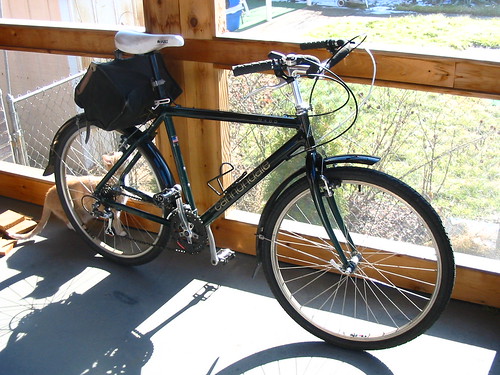
Cannondale, Revisited, originally uploaded by anklebiter_pgh.
Posted on 9 March 2007
I rode the Steamroller to work this morning, primarily because the brakes on the Cannondale are in need of adjustment (and I’m just not sure the cheap road levers have enough uumph to handle the cantis). Even with its low 42×18 gearing, I managed to cover the distance in roughly 100 minutes (give or take), which is only 10 minutes or so worse than the Cannondale (it’s worth noting the headwinds on the Island were relatively stiff this morning). I think I could probably up the gearing to 42×16 and still be fine, given that I was in the saddle for most of the California Avenue climb (and I tend to stand on most ascents). We’ll see how the rise on the McKees Rocks Bridge feels this afternoon. I doubt I’ll get around to adjusting the brakes on the Cannondale in the next few days, so it looks like the Surly will reprise its role as commuter, and I am not terribly upset about this. The bike just fits well.
That said, I may move forward with selling the Cannondale and build up a porteur/randonneuse with the SA speed hub and an old-ish road frame. I’m seeing Albatross bars, my saddlebag, 650B wheels….
Posted on 27 February 2007
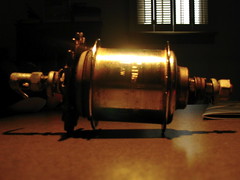
Future Plans
Originally uploaded by anklebiter_pgh.
A Sturmey Archer AW 3 speed hub, purchased for a song. I’m envisioning a city/stripped down short distance randonneuse, maybe with 650B wheels (I hear Kraynick has a pile of rims upstairs). We will see what the future holds.
Posted on 25 February 2007
Rod Dreher has written a bit on this essay by Paul Weyrich and William Lind concerning the future of Conservatism in the United States. The essay is interesting, and the authors clearly see where Conservatism has gone wrong in recent years, but their ideas also show what I believe to be the limitations of traditionalism, specifically what they term “retroculture.”
Now, Conservatism makes as one of its goals a deliberate recovery of the past, of those traditions that formed family and community. In one sense, this is appropriate goal, as those things to bind us to a place and other people are positive things (despite what you might hear). At the same time, of course, we must be wary of what Ivan Illich called the institutionalization of tradition–where the trappings of tradition become more important than the human relationships that tradition fosters. Wyrich and Lind then specifically pine for the 1950s, what they term “the last normal decade.” This strikes me as a bit of foggy nostalgia, as our culture tends to look back to the 50s as the decade of the nuclear family, where everything was wholesome. History, of course, tells us this is not the case. Jack Kerouac and the rest of Beats barreled to and fro across the country in search of, among other things, sex and drugs. Movies like Alfred Hitchcock’s Psycho and Billy Wilder’s Some Like It Hot, while considered tame by today’s standards, caused a furor among the religious community for their depictions of violence and sexuality. Additionally, public schools included both sex and drug education in their curriculum.
This is not say that Weyrich’s and Lind’s (and other traditionalists’) critique of our current culture is not correct, but I think it is a bit of a mistake to look back in time to recover something that was no more present than it is today. The point of tradition is to be reclaim something but to bind ourselves to something bigger than ourselves. Broken families are nothing new, and for many people, there is nothing to recover from their past. Culture will only be changed when we hunker down and take seriously the task of family. Without that anchor, little will change. And it is here, despite their pining for the past, that Weyrich and Lind are correct–cultural change is not at all political.
Now, there are some very valuable aspects to retroculture, specifically the recovery of convivial technologies. Weyrich and Lind very clearly align themselves to thinking of the reactionary James Kunstler:
Another old conservative issue the next conservatism should revive is aesthetics. America may be the richest nation in history, but that has not made it the most beautiful. Strip malls, suburban sprawl, and hollowed-out cities have created an environment few people can love. The New Urbanism offers an alternative that looks to the past to recover traditional designs for towns and cities. The next conservatism should incorporate New Urbanism but not on the Portland, Oregon model of urban growth boundaries and the like (inside of which you find, surprise, more sprawl!). Rather, the next conservatism should promote dual building codes. Developers could choose to build to existing sprawl codes or Traditional Neighborhood Design codes, depending on what they think the market wants.
Relatedly, the next conservatism should promote the return of trains and streetcars as alternatives to dependence on automobiles. The private automobile is a great way to travel as long as not many people have one. At present, the proliferation of cars creates such congestion that everyone, liberals and conservatives alike, wastes vast amounts of time sitting in traffic. Not even a Mercedes sports car is much fun when it can’t move. Bringing back trains and trolleys can save us time and help revitalize our cities. The future energy situation also makes it likely that coming generations will thank us for re-creating the network of trains and streetcar lines America once enjoyed. Here as elsewhere, the next conservatism should take the long view.
I cannot agree more. And this is as much of a recovery of the past as it is a fight of the future. And it at this point that contemporary Conservatism has fallen off the rails, so to speak. By insisting on the final authority of the Market and the pursuit of low prices, we have given ourselves over to dehumanizing technologies. Really, what Weyrich, Lind, and Kunstler advocate is a practical application of the discipline of place. This is, I think, less of a grounding in tradition, but in the people and place that fosters tradition.
Posted on 25 February 2007
I’ve done the new commute three times now. As providence would have it, those three days coincided with the worst of the weather for the past two weeks. Yesterday was a bit of watershed, I think, raising the bar of my tolerance for hideous conditions to new heights. In the first seven miles of the commute, I experienced (in no particular order) rain, snow, sleet, ice (always pleasant during a 30mph descent), hail, thunder and lightning. By the time I reached the base of California Avenue, I was wet, a bit cold, and utterly miserable. And I still had 13 miles to go, including the always-lovely crossing of Neville Island against what felt to be a 15mph headwind. Crossing the McKees Rocks Bridge, I received a Mr. Wizard-esque lesson on the Bernoulli Effect thanks to the crosswinds and the steady stream of tractor trailers. By the time I reached McKees Rocks, I wanted to stop, but that really wasn’t an option. What was I going to do? Turn around and ride home? Neville Island was better than expected–still a stiff headwind, but nothing terrible. The rest of the ride passed without incident. On the return trip, I enjoyed a fierce tailwind. On the flats of the island I was comfortably pushing my biggest gear. Gears can be fun.
Nearly each time, the ride is a rollercoaster of sorts, if you can pardon the cliché. There is always a time when I hate it, hate the new office, hate the job. It’s a surprisingly dark pit the industrial underbelly of the city can push you into. But once across Neville Island and the McKees Rocks Bridge, it all goes away, and I enjoy the ride, enjoy the feeling of the effort in my legs. And enjoy the stubbornness that gets me a through a wet, windy, cold ride, one where I get to my destination covered with grit and mud.
Posted on 23 February 2007
This evening marked my final ride home from the office in Allison Park. Fittingly, it was just starting to snow, though it was warm, at least compared to last week’s frigid spell, and the air was calm. The warm and stillness contributed to a good feeling in my legs, something that has been absent for what had seemed like weeks. I kept the pace high on the rollers on Mt. Royal, knowing this would be last time I would ride them with any regularity. I’m not sure I’ll miss this ride–the hills, though short, are steep, and there are days when you simply don’t want to put forth the effort. But that is part of the game, getting on the bike every day, regardless of how you feel or what the weather has given you. And I am at least a bit apprehensive about the new commute. After nearly 18 months, as much as I hated the hills, those roads were friends. I knew every pothole, every ripple of pavement, of those seven and half miles. That knowledge provided a certain comfort in my travels. Now, having only a single recce of the new route under my belt, I have nothing but uncertainty. I don’t know how well the various neighborhoods and towns I’ll pass through care for their roads when it snows. I will have to learn the patterns of traffic, acquaint myself with the regular commuters. Meet those people I will see everyday–crossing guards, pedestrians, even a driver here and there–whose nods and waves and hellos make the ride just a bit more bearable on days when it is hard to swing a leg over the saddle. It will fine, I suppose. Patterns will emerge, and what now seems like such a gargantuan task will become routine. All in a day’s work.
Posted on 12 February 2007
If you use an RSS reader to keep tabs on this or any other part of anklebiter.net, you should update your links.
I’m just sayin’.
Posted on 12 February 2007