Winner Tom Boonen had this to say about the state of the Koppenberg:
It is an extreme hill because there are no cobblestones on it. Certainly not on the last part, there they just threw a few rocks together. There are gaps of more than twenty centimetres between those stones. If someone falls between them, you’ll probably never see that person again. But it is part of the race. Just like the Valkenberg where I warned Bettini about the importance of it. Most riders think that it’s too far away from the finish. Not me, because it’s an ideal platform to attack if you feel good.
Tomorrow is the minor classic, the Gent-Wevelgem . Boonen will not likely be out for the victory, but expect him to push hard for his QuickStep teammates to position one of them for the win.
Posted on 4 April 2006
I rode what I thought would be a best-route scenario for next weekend’s alleycat today. While I’ve been happy with the layout we’ve selected, and the checkpoints that made the final cut, I was secretly worried the course would be too redundant to be any fun. Turns out it’s not. My navigation covered just over 13 miles (minus roughly a mile or so from the start line to the first checkpoint–I didn’t do it because it require too much backtracking given where we live) and took just under an hour (including an ATM stop). There’s only one real climb to speak of, and it should come pretty early in the race for most folks. There are, however, long sections of mostly flat, exposed racing, and if the winds are anything like they were today, pushing hard through them could be more taxing that the climb. The course seems to work well, and covers quite a bit of the city without requiring too much climbing (it is only April, you know–not everyone commutes year ’round).
I do have a map of my route that I passed along to my co-conspirators, but you don’t think I’m actually going to post that, do you?
Posted on 2 April 2006
If you’re a cycling fan, you wait for April all year. While the month of July often steals headlines here in the States because of the Tour de France, April is loaded with classic, notorious single day races. These are not races for the faint of heart, and most of the grand tour riders avoid them completely for fear of wrecking of their seasons with a single slip. The parcours take the racers over centuries old cobbled wagon paths, some barely big enough for the support vehicles to navigate. Add to this the brutal spring weather in Northern Europe–cold, wind, rain, and even sometimes snow–and you have races like no others. But the racers, especially the Belgians and French, covet these racers and seek to add good results to their palmares. For them, the season revolves around this month.
The fun began today in Belgium with the Tour of Flanders (better known as the Ronde van Vlaanderen). The race begins with a long, flat stretch near the western shore. The road, while generally smooth, is buffeted by heavy winds, and today, rain. This leads to a rollercoaster ride over some of the worst hills of the spring. These glorified cattle paths, like the Paterberg and the Koppenberg often force the racers to push their bikes in effort to get over them.
The favorite for today’s race was Tom Booen, who won the Ronde last year, and has already racked up eleven wins in the young season. It was up to the usual round of classic suspects to stop Boonen, but it wasn’t to be. Boonen and his QuickStep team shattered the peleton over the hills, and in the end, only Discovery Channel’s Leif Hoste could stay with Boonen. Hoste could not outsprint Boonen at the line, however, and Boonen defended his Ronde title. Discovery’s George Hincapie won the sprint for third among the chase group. Hincapie is likely disappointed by the result, though Disco should content to have riders on the podium–Hincapie has been the bridesmaid year after year in the classics, and this could be his last year to break through before he sets his sights on the grand tours.
The suffering continues next weekend, with Paris-Roubaix on Sunday, better known as the Hell of the North. Flatter than the Ronde, it is likely harder simply because there are more cobbles. Some of the nastier sections have been removed from the parcours (and for good reason–the roads have become little more than strips of dirt in the forest), but it is still a terribly hard race. Hincapie will look to shed his role as classics bridesmaid (he finished second there last year), and Boonen will be the favorite to score the Ronde-Roubaix double again this season.
Posted on 2 April 2006
A call from the optometrist, to tell me several orders of contact lenses had arrived, was enough of an excuse to leave work an hour early and enjoy what is the first true day of spring–sun, blue skies, and temperatures in the upper 60s. It’s been this warm already this year, but this day has the feel of springtime–the promise of warmth and sunshine, and the Earth shaking off its winter coat. The miles through the suburbs roll by. The traffic patterns are different, the flow of cars a bit heavier than at 5:00PM, and the sound and smell of things are different–stereos heard through open windows, the smell of perfume or perhaps after-shave as I roll by cars stopped at a traffic signal. By the time I reach the 62nd Street Bridge, I’m warm, too warm, and wondering why I’m wearing two pairs of socks. Habit, I suppose, from the winter. I cross the bridge, and a few minutes later, I’m at my front door, picking up the U-lock and removing clothes from my bag. Off to Oakland.
Riding in the city has become an entirely different experience. It’s so, well, easy. The roads are flat. Even the hills are flat, in a sense. You do a climb to get somewhere, and that’s it. On the commute, you do a climb, only to rollercoaster down the other side, quickly faced with another climb and another decent. On a fixed gear this leaves precious little time to relax (though after several years, one learns to “relax” on the downhills, even when spinning madly with an embarrassingly low 42×18 gearing). I bounce along Negley Avenue (will they ever fix the road surface?), racing the 71c between stops. Soon enough, I dart off Centre Avenue and into the residential neighborhood just east and north of Oakland. The sidewalks are full of people running (out for their first of year?) or returning from work. Jackets are slung over shoulders or tucked into bags.
Entering Oakland, on the first warm day of spring, while the universities are in full swing, is a sobering and depressing experience. I like to think of myself as young(ish). Yes, I’m not really, and I have two kids, but I don’t think of myself as being as old as I really am. Perhaps its because I ride a bike most everywhere, or that I wear jeans to work. Perhaps it’s bigger than that–a “mentality”–but either way, such a perception is shattered upon reaching Fifth and Bellefield, where the University of Pittsburgh campus begins. I am old. At least 15 years older than the average student that I pass in a blur. Old.
Traffic shakes me from my stupor and I’m weaving through pedestrians and locking my bike to a railing outside the optometrist’s office. I’m quickly in and out of the office, and heading down toward Forbes Avenue. Once there, I slide over to the right side of the road, riding past the throngs of people waiting for buses. As I pass the law building, I see a gaggle of hipsters, their fixed gears (mostly conversions) leaning against the low marble wall. Too bad I didn’t have alleycat flyers.
Cutting through traffic by the museums, I’m across Craig Street, back on Fifth Avenue, and soon away from the traffic in residential Shadyside. The streets are full (again) of people coming home from work, and runners. I take a circuitous route of backstreets to end up on Highland Avenue, thus avoiding Negley and its terrible road surface. East Liberty, within Penn Circle, is mayhem (as one would expect on such a day), with cars sitting in the middle of intersections, and pedestrians simply crossing the street without so much as looking. I’m through it without incident (and nary a stop), and I’m in Highland Park, happily spinning along. Rolling up to the front door, I figure today’s commute home to be in the neighborhood of 15-18 miles, not a bad way to christen spring.
Posted on 30 March 2006
I’ve been working on a rather long post about the question raised by Rod Dreher on the Crunchy Con blog–where do we go from here? Then Frederica Mathewes-Green posted this, distilling the answer perfectly:
And I think the best way to change a culture is to seed it with holy people. I think what’s made Evangelicalism less effective than it might be is a tendency to dream of big cultural-impact projects, rather than the humbler route of turning out millions of transformed, humble, holy people.
I’ve been reading Jacques Ellul’s The Presence of the Kingdom. For Ellul, the counter-cultural Christian must live, not act:
We have lost the meaning of true action, which is the testimony of a profound life, action which comes from the heart, which is the product of faith, and not of myth, or of propaganda, or of Mammon! What matters is to live, and not to act. In this world, this is a revolutionary attitude, for the world only desires (utilitarian) action and has no desire for life at all. We cannot exaggerate the significance of the fact of being spiritually alive.
Movements fail. The most effective reistence will always be living a holy and good life, aware of our failings, ever-focused on the Kingdom.
Posted on 28 March 2006
Basketball. Since Pitt has let me down (again) in the NCAA tournament, I’ve only been passively interested. I am, however, happy to see Ben Howland’s UCLA Bruins in the Final Four. Howland resurrected the Pitt program several years ago (and his successor Jamie Dixon has followed his blueprint for success, though not in the NCAA tournament), and it’s good to see Howland’s defense-first approach working on the West Coast (final score of the Memphis-UCLA regional final: 50-45). Many folks in Pittsburgh pilloried Howland when he decided to take his dream job three (I think) years ago, but who wouldn’t want to try and fill John Wooden’s shoes?
Rallying. I haven’t written much since the season began, but that’s because I’m not interested. Sebastien Loeb finally has some competition this season, with Marcus Gronholm’s switch to Ford provided the spark the Finn needed to launch a championship bid. Gronholm won Monte Carlo and Sweden, and Loeb has won Mexico and (this weekend) Spain. Gronholm slipped a bit in the standings because of an off in Mexico (to his credit, Gronholm clawed back to a points finish), and turbo issues in Spain (he still managed a podium finish). The Focus has shown great pace on tarmac, and before the turbo issues, Gronholm was holding the lead. Loeb has extened his championship lead a bit, but with a gaggle of gravel rallies coming up, Gronholm should be able to mount a serious challenge.
Posted on 26 March 2006
Slate‘s Field Maloney has examined the dark secrets of organic produce at Whole Foods. First, despite what is advertised, the bulk of the produce at any given store is not locally grown. Thus the thoughtful consumer is faced with a quandry–buy organic (which is arguably better for you and the enviromnent) or buy local (which probably isn’t organic, but doesn’t have to be shipped from who knows where to reach the cooler).
Let’s say you live in New York City and want to buy a pound of tomatoes in season. Say you can choose between conventionally grown New Jersey tomatoes or organic ones grown in Chile. Of course, the New Jersey tomatoes will be cheaper. They will also almost certainly be fresher, having traveled a fraction of the distance. But which is the more eco-conscious choice? In terms of energy savings, there’s no contest: Just think of the fossil fuels expended getting those organic tomatoes from Chile. Which brings us to the question: Setting aside freshness, price, and energy conservation, should a New Yorker just instinctively choose organic, even if the produce comes from Chile? A tough decision, but you can make a self-interested case for the social and economic benefit of going Jersey, especially if you prefer passing fields of tomatoes to fields of condominiums when you tour the Garden State.
I’ll also add something that Maloney failed to mention–not all organic produce is pesticide-free (this is truly one of the dark secrets of the trade). There is a list of chemicals (some more natural than others) that are permitted to be used on produce labeled “organic” by the USDA. You may think you’re getting pure, fresh. good-for-you apples when you buy organic, but you’ll likely have to do some legwork to determine if that’s really true.
Maloney’s point about the size of the average organic farm where Whole Foods might purchase produce is well-taken–much of the domestic organic crops come from large farms in California, where the methods more closely resemble the factory methods used on non-organic farms than the methods used by small organic growers. The average small organic farmer relies not Whole Foods and their ilk to make a living–most of their income comes from a combination of selling at local farmer’s markets, cooperatives, and community supported agriculture (CSA) programs where consumers actually purchase shares of a season’s crops. It’s not an easy living, but for many, especially in the east, it works. It works for the consumers as well, as they get fresher crops.
Of course, there are disadvantages. The consumer can be faced with limited choices, as not every crop can be grown everywhere. This is especially true when participating in CSA programs–you only get what the farm grows (it’s worth noting that many CSA farms, knowing their market, grow a wide variety of crops). Additionally, the consumer suddenly has to keep an eye on the weather patterns of the growing season as well–not enough rain or not enough sun could mean a more limited variety of crops. And a small farm can’t feed the world. In fact, most small farms would have trouble feeding a city. But enough of them could.
The surface that Maloney’s article scratches is that we as consumers must become more thoughtful about our purchases. Factory farming (organic and non) is slowly destroying a valuable way of life–that of the small farmer–in the name of progress and efficiency. And big box markets like Whole Foods are hastening this, somewhat unwittingly, by cutting into one of the remaining viable farming markets–organics. At the same time, however, CSA programs and co-ops are growing.
Posted on 20 March 2006
I’ve been meaning to write more about the book (really), but I just haven’t found the time. I do, however, think it’s worth noting this exchange between Rod Dreher and John Podhoretz on the Crunchy Con blog.
JPod begins:
Frederica complains that nobody wants to live in Old Charleston anymore because they’d prefer spanking new kitchens and more space between houses. Hello? According to what I’ve read, houses in Old Charleston sell for millions of dollars. That suggests a) people do want to live there and that b) almost nobody can afford to live there. Which brings up another point: The idea that people “choose” where they live. It’s never as simple as that. People live where in some proximity to where they work, and they want as much home as they can afford. They’re willing to brave traffic and, yes, even some appalling aesthetics to have the kind of home they want. Once again we see the key contradiction between the contributors to this blog and the vast majority of ordinary Americans. You guys live ideologically. You make choices that gratify you because they represent a fulfillment of ideas you hold. Most people don’t live this way, and to presume that they should is, well, the sheerest snobbery.
And Mr. Dreher fires back:
It is really quite something to read a conservative claiming that to live life according to one’s principles is “the sheerest snobbery.” Conservatism is elitist in the sense that it believes in standards. It believes that ideas have consequences, that some ideas are better than others, that there’s a way to live that’s better ? truer to our religious values, truer to human nature ? and that we shouldn’t be embarrassed to say so. I presume you are not a moral relativist or a populist, John. You have no problem telling people how you think they should live in other areas of their lives ? nor should you, as long as you are not obnoxious about it. You just don’t like that we try to apply conservative principles to the way we build the environment around us, so you engage in crude populism rather than make an argument about why our concerns are baseless. Try something different. You won’t get very far with a group of thoughtful conservatives by using “elitist” as a pejorative. We had all better be elitists about something!
JPod has yet to respond, but I’ll be interested to see how he saves face, since Dreher is correct.
Posted on 14 March 2006
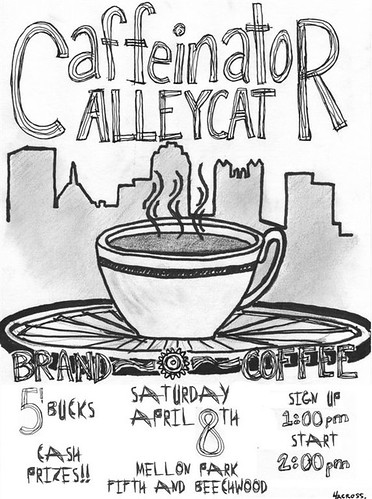
Registration begins at 1:00PM, Mellon Park. $5 to enter.
Race starts at 2:00PM.
Poster by Eli.
Posted on 12 March 2006
It’s official. I’m co-organizing an alleycat, the Caffeinator, for April 8. The theme? A tour of local independent coffeehouses. The distance will be in the neighborhood of 12-18 miles, depending on where we start and finish (these things are still under consideration). More information will be posted as I have it.
Posted on 9 March 2006