The Tough Choices

Caleb Stegall has made a late addition to version 2.3 of the New Pantagruel, Natural Law, the Death Penalty, and Political Theology: An Editorial Response to First Things. The essay is an examination of an apparent contradiction between FT editors on the matter of political theology, but as a response to that contradiction, Stegall begins to outline his own political theology, based in the writings of Augustine.

By recognizing and articulating clearly the source, location, and function of both the natural law and the Christian law, and by understanding them as mixed in an age that was passing away but which contained ?loved things held in common,? Augustine made a key breakthrough in the development of political theology which in its fundamental form remains valid today?a penitent, tragic political theology bound to pay an ongoing debt to nature yet cemented by a love that is both universal and particular: it transcends the City of God and orders all mankind; it is also concerned with the things of this world??the things which are passing away??and not with the things to come. However, this Augustinian balance has always been precarious. When the tension between the natural law and the Christian law collapses, the result is a disordering pressure either towards a rolling back of the protective shadow of the Christian law and engagement in the world wholly under the stark glare of nature which rewards only power and results in open tribal and political conflict, or towards a Gnostic denial of the reality of the law of nature and ideological attempts to remake the present age into the age to come.

Stegall’s reading of Augustine is not typical in Catholic and Reformed circles. Calvinists, in particular, see the work of the government as the work of God, and as such, it is a praiseworthy activity (I’m often frightened, really, by some Calvinist/conservative web sites that see the war on terrorism and the war in Iraq as God’s work). I’ve never been comfortable with such a perspective, and I’ve found the pacificist views of John Howard Yoder and Stanley Hauerwas to be in agrreement with Christ’s own teaching. But, a pacificist political theology is problematic. How does the State maintain order? Can the police use force? Is it permissiable to defend yourself? Christ tells us to turn the other cheek, but am I ready to turn if someone threatens my family?

The pacificist’s anti-war position is not difficult to defend. But things get sticky when we examine the use of violence by the State. Some pacificists believe that the State may use non-lethal force — rubber bullets or billy clubs — to maintain societal order. But this strikes me as sort of an odd compromise — violence is permissable in the name of order, but deadly violence isn’t. It is, however, the position of realist, understanding that a pacificist can’t have it both ways — no violence and societal order. We live in a fallen world, and life in that world is, to borrow a phrase, nasty, brutish, and short. The relative comfort in which we live is a result of a State which has used violence as a means to an end — to promote and maintain a (mostly) just and ordered society*.

It is here that Stegall’s perspective on Augustine’s “penitent, tragic political theology” separates from the typical evangelical and even reformed theology — this necessity of maintaining social order in the City of Man requires that those involved in the politcal process be prepared to “sin boldy” and understand that societal order does not always mesh easily with God’s commands. Many in the reformed tradition (beginning, of course, with Calvin) view the responsibilities of civil government as mandated, and blessed, by God — including war and capital punishment — and that those who are called into civil service are worthy of praise for fulfilling these responsibilities. I’ve never been particularly comfortable with this political theology, given my pacificist leanings, and what Christ had to say. At the same, I don’t have many good answers for political questions, and the challenge of what is to be done to maintain order in society, and, more importantly, what is to be done if my family is threatened.

It’s somewhat therapeutic to examine the life and work of Dietrich Bonhoeffer. Bonhoeffer was a committed pacificist, but when faced with the horror that was the Third Reich, Bonhoeffer realized that such an evil could not simply be overcome by turning the other cheek. To that end, Bonhoeffer joined Abwehr resistance (though there is much speculation as to the extent of his participation). Bonhoeffer, however, struggled with his participation as he understood that violence undermined the Gospel message. Yet he also understood that Hitler could not be defeated with non-violent resistance, and therefore decided to “sin boldly” and join the fight. John de Gruchy, reviewing Stanley Hauerwas’ Performing the Faith: Bonhoeffer and the Practice of Nonviolence, says:

Bonhoeffer?s reluctant involvement in the conspiracy against Hitler certainly does not provide unambiguous Christian justification for resorting to violence and war. He knew only too well that even a “just war” is still war with all its awful consequences. Rather, Bonhoeffer confronts us as someone who, in following Christ, made a personally costly decision that doing nothing to rid the world of Hitler was worse than doing what he did, however ambiguous the moral issues. That is what peacemaking demanded of him at that time and place. In making that decision he could only “sin boldly” and cast himself on the grace of God.

Of course, Bonhoeffer’s case is one of extremes. But the point remains — the business of life in the City of Man is a dirty one. What remains is our response. The pacifists hold a Biblical truth, as given in the Sermon on the Mount, that we are to be peacemakers, and that we should not repay violence with violence. I’d like to fancy myself a true pacifist, but I cannot account for two things: 1) How do I respond when my family is threatened? and 2) Can I really expect the City of Man to survive without the force wielded by the civil authorities? These questions carry their own sets of problems. Should Christians really be concerned with the state of the City of Man? Why not go the way of the anarachists and wish away society completely. Yet such theology seems disingenuous — here I am, the anarchist, living in my house in a city, using public utilities, under the protection of the civil government. Even if I don’t rely on the services of government — we move out of the city and off the grid — we still live in the long shadow in the fruits of the State.

Tough choices indeed. Stegall’s reading of Augustine is comforting in its humility. We will fail God in the City of Man, maintaining our families and our communities, and we can do little more than throw ourselves at the feet of Christ and ask for His mercy. Mistakes will be made. We can only hope “[I]f the mercy is true, you must therefore bear the true, not an imaginary sin. God does not save those who are only imaginary sinners. Be a sinner, and let your sins be strong (sin boldly), but let your trust in Christ be stronger, and rejoice in Christ who is the victor over sin, death, and the world. We will commit sins while we are here, for this life is not a place where justice resides. We, however, says Peter (2. Peter 3:13) are looking forward to a new heaven and a new earth where justice will reign.

* It can be argued that our society is only ordered and just for a selection of the population, but I would counter that the majority of citizens live in relative safety.

Remembering Warmer Days

drew at coopers

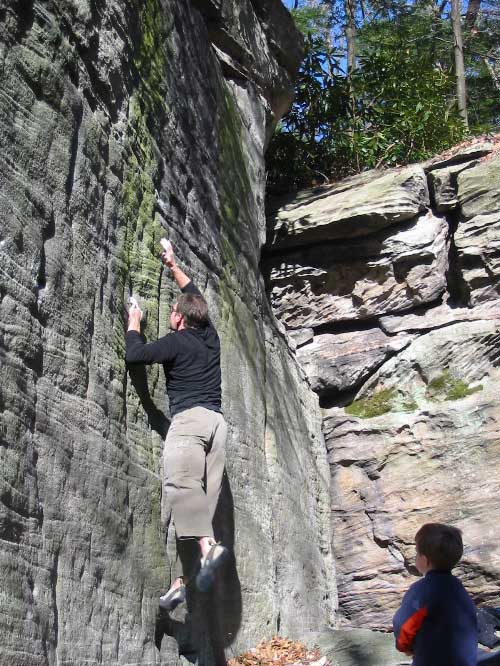
Sebastien giving Drew a proper English spot on Mountaineers Route, Coopers Rock State Forest.

The Economics of Fair Trade

David Koyzis has opened a discussion about this essay from the Action Institute regarding the economic validity of fair trade practices as they apply to the coffee industry. I’ve already added my two pence to the discussion on Dr. Koyzis’ site, and I need to do more homework to write anything further. I do, however, want to underscore one comment from the discussion, from Pantagruelist Caleb Stegall:

The error both fair traders and Acton fall into is the same, and it isn’t an economic error but a moral failing. Both arrogantly assume that a subsistence peasantry is a mean and ugly thing and a blight on the modern enlightened world. Both seek to destroy said peasantry either by enslaving them to markets or entitlements.

There’s much truth to that. Two things in response. First, as I said in the discussion, I’d rather err on the side of the fair trade model than the free market model. In the end, even if the farmer’s become enslaved to entitlements, they’re likely better off. Second, I think there are ways to work within the Fair Trade model without rearranging the culture of farming within the communities. Companies like Dean’s Beans focus on doing what the farming communities need, not what the company thinks the communities need.

Practical Art

Last night, as part of Jen’s birthday celebration, we went to hear Ted Kooser, the current Poet Laureate, speak at Chatham College. Jen has read several of Kooser’s books of prose for her coursework, and she has spoken well of him, so I gladly went along. I was intrigued because Kooser has fashioned himself as a bit of localist, staying close to his Midwestern roots, and focusing his writing around his home.

Kooser didn’t read much, instead providing a humorous biographical sketch and then taking questions from the audience. I was struck by two things — his humility and his emphasis on accessible art, especially poetry. Kooser may strike some as an unlikely Poet Laureate. He spend 35 or so years as a desk jockey at an insurance company, writing his poetry in the mornings before he left for the office. Kooser was also quite critical of the vicious circle that literary criticism has created — in order for critics to properly write, they must examine art that must interpreted. In turn, writers create denser and denser art to feed the critics (and get published). He specifically mentioned Pound and Eliot — poets who required a profound amount of knowledge just to approach their work. Kooser believes art must be accessible, and he writes not for the academic crowd, but for, as an example, the people he worked with before he retired. To that end, Kooser’s poetry and prose tends to be abundantly descriptive and focused.

The talk reminded me of this post by Maclin Horton:

It helps to alleviate the melancholy of contemplating these situations to remember that in none of them do we know the end of the story. Many years ago, in the mid-1970s, I made the decision, for purely pragmatic reasons, to give up my plans for an academic career in literature and to take up a practical trade, studying computer science. Some time after that I ran into an acquaintance whom I hadn?t seen for five or six years. We were standing in line for something or other and briefly catching up on what each of us had been doing. I told him I was learning to be a computer programmer and added, perhaps a bit defensively, that this was an odd place for me to end up. He replied, “Well, maybe you ain’t finished ending up yet.”

Food for Thought

I haven’t had the motivation to write a coherent, cohesive entry for some time, so here are some quick hits. Hopefully many will be given a better treatment sometime soon….

On the commute

I’ve really come to enjoy the new ride. Instead of fighting traffic, weaving in and out of cars, and trying to time traffics, I’m treating to a ride over the river as the sun crests the horizon, followed by two miles of gentle spinning in a wooded valley with a creek to my side, and then four miles of rolling hills on a lightly used road. The ride home is even better, hitting the valley as night falls, this evening under the light of an almost full moon. My bike has nearly completed the transformation from street-saavy track bike to utilitarian commuter. I’ve just installed a headlight, as roughly a third of the ride home does not have the luxury of street lights. I’ve even bolted a water bottle cage to the frame, albeit to carry the battery for the lamp. I’m now faced with the dilemma of upsizing my rear cog a bit to ease the ride as the week comes to an end.

Politics

There’s the beginnings of what should be an interesting discussion on the immediate future of politics in the United States here. Unfortunately, you must, unfortunately, be blessed by the Nocturnal Council to post.

World Rally Championship

The 2005 campaign ended this weekend in Australia without much fanfare, as Sebastien Loeb secured the title roughly four rallies ago. Loeb did have something to gun for, however, as he could break the record for rally wins in a season (10). It wasn’t to be, however, as the normally fast rally turned into a war of attrition as Loeb crashed out on Leg 1, followed by Marcus Gronholm, Colin McRae and Petter Solberg. Francois Duval salvaged his lackluster season by inheriting the win, with Mitsubishi’s Harri Rovanpera and privateer Manfred Stohl rounding out the podium.

It should be an interesting off season, as both Citroen and Peugeot will take at least a one year sabbatical from the championship. Loeb has signed with the privateer Kronos team to continue behind the wheel of Citroen. Loeb will maintain his ties with the French outfit in order to reclaim his factory seat when Citroen returns to the championship. Marcus Gronholm has signed with Ford for 2006, leading what could be a very promising charge for the Blue Oval. Duval and Peugeot’s Markko Martin have not secured drives for next season however. Only Subaru has set their roster, with both Solberg and youngster Chris Atkinson returning. Mitsubishi has also indicated it will keep its current lineup of Gigi Galli and Harri Rovanpera, with Gilles Panizzi driving a third works cars on the sealed surface events. Ford has not yet indicated if it will retain Toni Gardemeister for the second factory seat next to Gronholm. It’s expected that the Blue Oval won’t make a move until Martin’s status is known. Skoda will also have an open seat, with the retirement of Armin Schwarz. There are rumors that McRae would ink a deal for a fulltime drive with the Czech outfit.

Local News (or the Long, Slow Death of Public Education in Pittsburgh)

Last night, Pittsburgh Public Schools Superintendent Mark Roosevelt, announced a plan to close 20 city schools as both a cost cutting measure and a way to be serve the youth of Pittsburgh. this map shows the schools that will close or be relocated. I’m not sure what to think about the closing of the Morningside grade school (the one right across the street from our house). There are some in the neighborhood who don’t like it, and believe it brings the wrong sorts of kids into the neighborhood, but our jury is still out. I do know that an abandoned building isn’t likely to help the neighborhood much, either.

Local Events

Via the Thomas Merton Center, there is a series of discussions at the Squirrel Hill Branch of the Carnegie Library about Christianity and its response to socio-economic issues. Tonight the discussion will center on the environment as a Christian concern, and future discussions will look at Christianity and factory farming, and Christianity and the consumer culture.

It’s really too bad these discussions happen at 5:30 PM. I’d love to go.

Grandpaps

The article below was published many years ago (I’d reckon at least twenty) in a glossy Pittsburgh magazine. Growing up, my family lived in an neighborhood in the east end of the city, surrounded by my mother’s family. The entire neighborhood was at one time owned by my great grandfather, but over the years, he parceled the land and sold it away. Still, most of his immediate family still lived in the neighborhood, congregated in houses along The Drive. That’s where I grew up. The article was written as a tribute to my great grandfather. The author was a neighbor, Chuck Husak — an outsider, as it were — who found some inspiration in the life of Anthony Yacaboni.

My neighbor Mitch is raking leaves in his backyard looking like someone laced his Maxwell House with amphetamines. What’s stranger, it’s Sunday afternoon, the time of the week he can’t be budged from his football games. He explains by nodding toward an upstairs window in the big red house next door. “The eyes are upon me,” he says, the words of a beaten man.

Instantly, I understand. Mitch is doomed to rake until he gets his lawn pooltable perfect. The eyes, of course, belong to Grandpaps.

Anthony Yacaboni is ninety-one now, getting stronger every day. He’s Johnny Appleseed, Picasso, Buckmeister Fuller, and Will Geer. He’s a prime mover and a motivator. A man who, with his bare hands, designed and built an entire neighborhood from scratch. A man who uses hedge clippers the way a neurosurgeon uses hemostats. A man who looks at an old stump, and envisions a table, and presents you with an extraordinary piece of hand-hewn furniture two days later. A man who could tell Marlin Perkins a few things about wild birds. And Ewell Gibbons a few things about wild hickory nuts.

To full experience the scope of this man, it’s first necessary to experience The Drive — a plot of land tucked away in a corner of East Liberty, bearing little resemblence to the rest of that concrete community. The Drive is a five acre, wooded fairyland, complete with flowers, manicured hedges, goldfish ponds, stone statues, vegetable gardens, flagstone paths, pheasants, raccoons, and six rather unusual homes, all connected by a winding lane known as, if you’re catching on, The Drive.

The Drive takes on different aspects in different seasons. IN the fall, you’re reminded of a postcard from Vermont. In winter, the scenario from Robert Frost’s Stopping By Woods On A Snowy Evening. Springtime, a set from Babes in Toyland. In the summer, The Drive is nothing less than a giant, spectacular miniature golf course. This is the domain of Grandpaps.

A landscaper in his working days, Grandpaps bought this piece of land when it was just a field around 1921. With his shovel, wheelbarrow and back, he transformed it into the kind of showplace that never fails to drop people’s jaws the first time they see it. Drive residents have heard the comments before. “How’d you ever find this place, man?” “I thought Disneyland was in Florida.” Or just “I don’t believe it.”

As his family grew, Grandpaps and his sons built homes to accomodate the Yacaboni clan. One son, and architect, built an experimental dome house that looks like something out of Close Encounters. Another house has a 50-foot tulip tree coming up through the living room floor, out through a skylight in the ceiling. Today, four generations of Yacaboni descendants inhabit The Drive. And a handful of “outsiders” like myself.

Grandpaps comes down for a visit. He walks you around the grounds, pointing at towering trees. “I planted 57 years ago,” he says with a thick Italian accent that keeps you listening closely. He stops at a little alcove with stone benches designed so ingeniously they look like a natural formation. “I carried each rock, one at a time.” Suddenly, it dawns on you that most people don’t know what hard work really is.

It’s commonplace when the weather’s not too rude to come home at night and find all your leaves raked into a gigantic pile. Or all your bushes trimmed, the clippings stacked neatly, ready for disposal. Grandpaps, helping out.

He points outs various projects you may want to consider. “Build wood floor, put garbage cans on top, move over here so no one sees.” Moments later, after he leaves, you find yourself looking around for two-by-fours, your plans for the day postponed.

Grandpaps in his toolshed. A rickety shack, decked out his antique hoes, saws, and shovels, old burlap sacks, push lawnmowers, flower pots, and handyman bric-a-brac, the feeling inside is almost religious. As if you’re in a chapel, surrounded by holy, ancient artifacts. The handles on the tools are worn smooth from his hands. Each tool broke years ago, was mended in earnest, broke again years later and was again fixed. These are honest-to-goodness tools, the real McCoy, Harley-Davidson heavy duty, forged in cast iron. Absolutely nothing in common with the plastic rake I bought at Sears for $3.99, then hid so Grandpaps wouldn’t find it and think I was some kind of jerk for buying. When he found it, he tactfully ignored it. Next day, he brought down his personal, pre-World War II indestructo-rake and demonstrated how to use it, remarked that I needed it more than he, turned and hiked back up The Drive. Anthony Yacaboni knows when he’s made his point.

This is the summertime Grandpaps, whipping The Drive into shape, doing the outdoor things he values highest. In many ways, his winter itinerary is even more remarkable. That’s when he takes his show inside the big red house he shares with his daughter and son-in-law.

Grandpaps leads you through the hallways, pausing to chuckle softly at the various knick-knacks he’s fashioned, as if he fondly recalls a special story behind each piece. He catches me admiring an old pastel-tinted photo of a heroic military figure on a charging stallion. “Italian cavalry, nineteen-fifteen,” he says with pride and affection. It’s Grandpaps himself in the picture, looking like Errol Flynn.

Down in his basement, Grandpaps works quietly, deliberately. Most everyone on The Drive has one of his hand-made bread baskets. Solid, intricate, proverbial old-world craftsmanship. His matching wicker wine bottle decanters are just as perfect. But Grandpaps is just tinkering.

He takes his stonework a litte more seriously. Tiny mantlepiece miniatures, oversize garden totems. Each with the unmistakable lines that are distinctively Grandpaps.

His work is priceless. Not because art collectors open bidding wars for his pieces. They well might, but Grandpaps’ work simply isn’t for sale. He’ll give you one, if you’re the mailman, the water meter reader, or just a neighbor. One day he’ll walk down, present you with his latest creation, wave off your thanks and wave so long. He know you’re grateful, and that’s enough.

So what’s his secret? Where does it say a 91-year old man should be able to pull weeds all afternoon, shoulder-to-shoulder with people one-third his age and end up with a bigger pile to show for it?

Well, he has several cousins close to his age, so longevity is a Yacaboni family trait. But he hasn’t smoked or had a drink in 60 years, either. And ever since an ulcer that came and went in (Teddy) Roosevelt’s term, he’s been a rather bland diet that never varies: fruit, some eggs, lots of cream and butter, home-grown vegetables, cottage cheese, creamy soup, occasional fish and poultry. Out are all spices, all sweets, tomato sauce, and all meat. It works.

If there’s a common feeling among all who meets Grandpaps, it’s best described as humble. He’s simply an overwhelming presence. More than anything, you want to do something for him. Show him something he’ll approve of — something you built or painted, some little invention you thought of first. But you may as well try to outperfrom Bruce Springsteen.

What he really likes, and it’s really all the rest of us can offer, is when we get up, get outside and dig, pull, chop and trim, doing our part to keep his Drive the only way he’ll tolerate it. Perfect.

To Mitch and me, it looks like the lawn is about finished. But on The Drive, final approval on such matters comes from a higher authority. So Mitch, the eyes upon him, keeps raking.

Halloween Alleycat — A Different View

Yesterday was the Spirit of the Streets race. Having done seven or eight races in the last eighteen months, I thought I’d offer my services as a volunteer, and the organizer, Brad from Dirt Rag, accepted my offer. There would be two races:

1. The citizens’ race: a combination scavenger hunt/point-to-point race with four checkpoints. Riders could hit the checkpoints in any order, and would be asked to complete a task to get their tag. I was stationed at the mouth of Point State Park in town, armed with circus peanuts and canned pumpkin — racers had to eat one or other. Other checkpoints were Washington’s Landing, the lake at Panther Hollow, and the bottom of 18th Street in the South Side.

2. The “pro” race: Same checkpoints as above, minus the activities. The riders, however, had to hit the checkpoints in a particular order, bumping the total distance of the race to roughly 20 miles. Winner takes all.

Costumes were required (I was dressed as a 1950s era racer, complete with a leather hairnet — thanks to Dave — pictures may be forthcoming).

Around 4:30PM I left the dinosaur in Oakland with cans of pumpkin and bags of circus peanuts in my bag for the lonely riding down Fifth Avenue to the Point. The winds were swirling, and for a moment I was happy I wasn’t racing. Ten minutes later I was unpacking my wares, and filling dixie cups with pumpkin. My initial spot, under an oak tree in front of the Hilton, turned out to be a bad idea, as acorns were falling almost constantly, with a few bouncing into the cups of pumpkin. Oops. Remember to warn the racers about that.

Ten minutes after the race start at 5:00PM, the first of the pro racers appeared (mine was the first stop). Nothing terribly out of the ordinary happened at the checkpoint (aside from a few folks having to spit acorns out of their mouths — sorry about that), so instead of rehashing boring details, I’ll list a few of the interesting bikes that passed through.

* The winner of the pro race was riding an old, old ten speed, complete with a milk crate bungied to the rear rack. Awesome.
* The very nice, red and white custom Jonny Cycles. I wasn’t a big fan of the bullhorns on it, but otherwise, a very sharp track bike.
* The Soma cyclocross bike riden by a girl in a lion costume. Yeah, it had 20 gears too many, but it was a fine looking ride.
* The new Lemond singlespeed. Another sharp looking ride — black frame with white decals.
* Brad’s Vivalo keirin frame, straight from Japan.
* Jason’s urban trials machine — 32×16 singlespeed. He ran the pro class and didn’t come in last place.

When I left my station and went to Duke’s for the awards and to return the remainder of the circus peanuts (apparently Brad loves them — more power to him), I took joy in the sight of nearly fifty bikes locked and hanging from the chainlink fence encircling the construction site next door. Why didn’t I bring my camera?

Why I Don’t Dance

good grief

From Dave and Casey’s wedding.