Gideon Strauss has written what seems to be the theological and philosophical basis for being a hacker:
I really like the notion that most of us are vocational experts in a limited number of areas of life, and at the same time responsible for being thoughtful amateurs in several more areas of life.
That’s the whole idea behind being a hacker — choosing to meddle in everything and anything to learn how it works. The more we know about the world around us, the better off we are.
Posted on 13 October 2004
I’m really not a baseball, at all, but I sorta wish I could watch the Yankees/Red Sox playoff series. Honestly, regardless of what happens in the World Series (even if an NL team beats this series’ winner), this is the best thing to happen to baseball.
Posted on 12 October 2004
One of the founding fathers of deconstruction, Jacques Derrida, has died. Leave it to Gregg Easterbrook to write a moving eulogy:
The philosopher Jacques Derrida died Friday. Few thinkers have had more impact for such recondite ideas. Derrida was given to gibberish pronouncements such as “deconstruction, if there is such a thing, takes places as the experience of the impossible.” His followers received such words as oracular while his detractors received them as threats to Western civilization. (TMQ received them as gibberish.) Derrida believed writers never truly control what they say because limitations of language and social structure impose barriers no writer can evade; this is an important idea that should have lasting merit in literary criticism. The idea is also easy to satirize — if an author’s intent “cannot overcome the inherent contradictions of language itself, robbing texts of truthfulness, absolute meaning and permanence,” as the New York Times said in its obituary, then Derrida’s own theory may not be truthful, and if his own theory isn’t true then maybe writers can in fact control their words and convey absolute truth, and so on. At least Derrida got people excited about intellectual theory, which is more than we can say for most intellectuals.
While I agree with Easterbrook (at least the part about the gibberish), there is a fundamental truth in what Derrida had to say — the limitations of language do built barriers for the writer. If you’re at all versed in literary criticism, but don’t subscribe to deconstructivist theories, you can’t really argue with this point, otherwise, well, what’s the point of the other schools of critical thought? If what the writer meant is really there and not limited by language or social structures, then why critique it at all? Perhaps only Formalism would remain.
Posted on 12 October 2004
We had the first of (hopefully) many discussions at our house last night with a few other folks from our church. The idea is to find interesting/challenging articles and papers about “faith in the public square” and how we should interact with culture as Christians. First, a quick rundown of who was there:
* A CMU professor
* A doctoral candidate from Pitt (studying the philosophy of science)
* A part-time college instructor (holding a PhD in theology)
* A employee of the chemistry department at Duquesne
* Jen
* me
Not exactly a bunch of intellectual slackers. In fact, I’m the only one not involved in higher education at all. We got together to talk about Reformational Christian Philosophy and Christian College Education by Calvin Seerveld. Seerveld is an leader in the neo-calvinism movement within Reformed theology (see some of my sidebar links for more neo-calvinism). The article, a lecture delivered by Seerveld at Dordt College (a bastion of neo-calvinist thought), outlined his vision for a Reformed perspective on higher education. I won’t rehash the article here, but I would like to talk about my reactions to it, and the discussion that followed.
First, I find myself to be in a bit of conflict with many neo-calvinistas (Gideon Strauss’ term) because of their perspective on eduction, as outlined by Seerveld. Though they put an emphasis on “reforming creation” by letting their faith and knowledge of God define their task/vocation, often that “reformational” act never leaves the safe confines of the Reformed university setting. We can become far too comfortable debating theological/philosophical issues with our Christian peers (who will never disagree on an atomic level — they obviously share our basic religious beliefs). But how does that reformed education help us debate with the larger world (in neo-calvinist parlance — how do we reform that sphere in which we operate?)?
One thing I learned from the discussion was that I couldn’t let myself become too insular in what I read. Sure, the neo-calvinists are interesting, and I share a lot of common ground with them, but that’s no reason to ignore other voices. I think important sources of information/thought could be First Things and The New Pantagruel, which are heavily influenced by both reformed and Catholic thought. And guess what? We all share many of the same ideas about “faith in the public square.” And I think the folks in this group will help to keep me in the right direction, since not everyone shares my interest in neo-calvinist thought.
Posted on 8 October 2004
There will be a halloween alleycat here in Pittsburgh, albeit on October 30. Not many details yet, but it’ll start at the Mr Roboto Project in Wilkinsburg at 8:30pm. Cost is $5. A good time will be had by all.
Posted on 5 October 2004
Petter Solberg cruised to his third consecutive rally win on Sunday, setting 13 of 19 scratch times. But the win did little for his title hopes, as Sebastien Loeb finished second, giving up only two championship to Solberg. Loeb’s lead stands at 26 points with only 30 left on the table. Solberg has promised to fight to the bitter end, and given his speed over the last couple of months, he should be on the podium for the rest of the year, but unless Loeb runs into serious problems, he should cruise to the title.
Citroen’s Carlos Sainz put in another fine performance in third place. Only two other factory cars managed to score — Ford’s Francois Duval in fifth and Peugeot’s Marcus Gronholm in seventh. Fourth, sixth, and eighth were filled with privateers, though sixth place finisher Gianluigi Galli has driven a factory Lancer this season.
Next up on the calender is France, with it’s tight and quick tarmac stages. Loeb will be the man to beat, and even with his speed as of late, it will take another miracle/disaster for Solberg to win (last year Loeb had problems in the rain and Solberg won). Loeb can wrap up the championship with a podium finish.
The manufacturer’s race has heated up some, with Subaru within striking distance of Ford in second place. Ford had a terrible rally in Italy, and given Mikko Hirvonen’s speed, Subaru could overtake Ford in France.
Posted on 4 October 2004
Petter Solberg is firming in control of the rally, but with Sebastien Loeb comfortably holding second place, it does little to help his title defence. Marcus Gronholm held second place through most of the day til turbo problems got the better of his Peugeot, and the Finn lost over 23 minutes to the leaders, though, unusually, Gronholm didn’t retire, and he managed to stay at the top of the time tables for the rest of the day. This was bad news for Solberg, however, as Loeb moved in second place, and with Carlos Sainz over a minute behind the Frenchman, there was little chance of Loeb protecting his championship lead.
There will be a podium battle, however, with Markko Martin just behind Carlos Sainz. Martin hasn’t been happy with his Focus, and he’s really been off the pace, but he will push Sainz tomorrow. The rest of the points places are filled with privateers taking advantage of the high rate of factory car attrition (Harri Rovanpera, Mikko Hirvonen, Armin Schwarz, Toni Gardenmeister).
Posted on 2 October 2004
A switch for this year’s rally in Italy — instead of the sealed roads of San Remo, the WRC comes to the island of Sardina, with it’s narrow, sandy roads. Both Sebastien Loeb and Petter Solberg downplayed their chances to win, given their unenviable tasks of running first on the roads on day one, acting as sweepers for everyone else.
But, heading into the day’s last service, Petter Solberg is holding a thirty second lead over Marcus Gronholm and Sebastien Loeb. Markko Martin is fourth, Carlos Sainz fifth, Harri Rovanpera sixth, and Francois Duval seventh. All are less than 60 seconds behind Solberg, though this gap should grow greater as the drivers make their second pass through the opening stages, negating an any disadvantage Solberg and Loeb have.
End of Leg Update
Solberg will take a 30 second lead over Marcus Gronholm into Leg 2. Sebastien Loeb is lurking close behind, 34 seconds off Solberg’s pace. The rest of the field is slowing slipping away, with Markko Martin just under a minute behind Solberg. The reigning champ will be running last on the road tomorrow, giving him the opportunity to adjust his pace according to Loeb and Gronholm, and Solberg generally does well holding onto a lead.
Posted on 1 October 2004
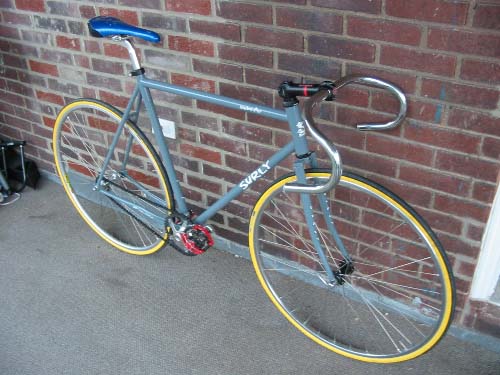
Components
Frame/Fork: Surly Steamroller, 56cm
Wheels: Mavic MA3 rims. Rear Suzue track hub. Front Shimano.
Tires: Clemente Monzas
Cranks: Truvativ Elita. 42 tooth chainring (generic)
Bottom Bracket: Truvativ ISIS Drive IS, 68mm x 108mm
Pedals: Shimano Downhill SPDs (old)
Chain: Taya Track
Cog/Lockring: Surly 16 tooth
Seat/Seatpost: Selle Italia Nitrox/Generic
Stem: Bontranger Race
Handlebars: Nitto NJS track
Headset: Ritchey Logic, threadless, 1 1/8″
I don’t have a final total, but I do know that I spent less than I would have buying a Bianchi Pista, Fuji, or KHS track model complete. I could have saved a few more bucks if I would have had the time to install the headset at Kraynick’s, but the extra $20 didn’t break the bank.
Posted on 29 September 2004
Slate has a nice article pointing out the incredible stupidity of honoring Che Guevara as a freedom fighter. Just a few of the “freedoms” he brought to Cuba:
* Labor camps used to “disappear” dissidents, gays, and AIDS victims.
* Revolutionary firing squads.
* A totalitarian regime.
Yes, a shining example of a freedom fighter if I’ve ever seen one.
Posted on 29 September 2004