I do not always find myself in agreement with what James Smith writes, but his essay on the Comment website, “Loving our neighbour(hood)s: The architecture of altruism,” hits the mark. Smith wonders:
What if our built environment were less sequestering and insulated? What if we dwelt in houses with front porches on the sidewalk—and actually spent time there, chatting with neighbours who strolled by? What if we began our day not by jumping alone into the Camry in a dark garage, but by walking a few blocks to catch the bus, which we rode with others, gradually building up familiarity and even friendship with a cross-section of the city we could never see from inside our automobiles? We would then inhabit a built environment that would give the neighbour a chance to appear. Fostering such environments would be a way to love our neighbours. Disciples of Jesus could commit themselves to an architecture of altruism as a way of loving God.
This is one of the greatest benefits of commuting by bike. Over weeks and months, the nods of acknowledgment to passers-by become friendly waves and eventually “Good morning!” These are indeed moments that will rarely happen in a car.
I’m sure that some may take Dr. Smith’s essay as an indictment of the suburban, and, in a sense, I suppose it is. If real community exists, often it is in spite of architecture and civil planning, not because of it. And, of course, there are plenty of urban neighborhoods were sidewalks and porches do little to foster the sort of attitude that Smith outlines, but that’s not say we shouldn’t pursue such a vision. Interestingly, such a vision spans political boundaries, from the socialism of Ruskin to the front porch anarchism of Bill Kauffman. This is no coincidence, I think.
Posted on 3 August 2007
Rod Dreher is wringng his hands over the lack of “real men” in many Christian denominations (and pointing out how the Orthodox don’t have these problems). And I’m not sure why. Dreher quotes an article that appears in the Washington Post about this trend in Protestant denominations:
“Every Muslim man knows that he is locked in a great battle between good and evil, and although that was a prevalent teaching in Christianity until about 100 years ago, today it’s primarily about having a relationship with a man who loves you unconditionally,” Murrow said.
“And if that’s the punch line of the Gospel, then you’re going to have a lot more women than men taking you up on your offer because women are interested in a personal relationship with a man who loves you unconditionally. Men, generally, are not.”
But, um, isn’t this what the Gospel is about? Yes, Jesus (and Paul) spoke about spiritual warfare, but He also spoke volumes about love. What are the fruits of the Spirit? Love? Joy? Peace? Not very manly, eh? Dreher continues:
Another thing: I believe one reason so many male Christians responded deeply to Mel Gibson’s “The Passion of the Christ” was because it depicted a masculine Jesus who chose to endure excruciating pain to rescue those he loved. The Christian faith teaches that this is what Jesus did, but somehow the intense physical courage that that act of love required is easy to overlook. Gibson didn’t overlook it. The Jesus Christ of his film embodied manliness par excellence: a strong, brave man who was willing to suffer and die to save others. After I saw that film in a press preview, then went to Ash Wednesday services and heard the plush priest give a homily about how Lent is really supposed to be about learning to love ourselves more, I wanted to slug the guy.
Certainly Jesus endured terrible suffering. But the night before He prayed to His Father, asking that this burden pass of Him. What is odd about this post is that Dreher and other tradtionalists often beat their breasts over what they perceive as the “therapeutic” Church–we expect our church experiences to speak directly to our needs and problems instead of being worship in the presence of the Almighty. But if make worship more masculine, aren’t we doing the very same thing?
Posted on 3 August 2007
34 miles
I actually rode with other people today, tagging along with some of the racer boys on an easy ride. The climb at the start of Middle Road is quite nice, and I’ve realized that I need to teach myself that it’s entirely possible (and okay) to downshift and climb slowly. There’s no need to attack every hill, as fun as that is.
Posted on 28 July 2007
Tour de France leader Michael Rasmussen has been sacked by his team, Rabobank, and removed from the Tour. Apparently pressure from the board of directors led to his dismissal, which is not at all unexpected, given that the race director suggested the Dane was a cheat, and fans booed him on his way to a stage win today. This leaves Alberto Contador in the yellow, Cadel Evans in second, and American Levi Leipheimer in third. I suppose this is better than Rasmussen winning and then failing a doping control like our friend Floyd Landis. Discovery Channel (who sponsors both Contador and Leipheimer) is rather subdued over the events, as no one ever wants to inherit a win in such circumstances. Unless Contador really has a bad ride during Saturday’s time trial, or Leipheimer a spectacular, I don’t see anything changing between now and Paris.
Oh, and a Confidis rider, Cristian Moreni, failed a doping control for unusually high levels of testosterone. Ironically, Moreni was part of a riders’ demostration before the start of today’s stage protesting the rampant use of drugs in the peleton. Oops.
Tarik Saleh has a fine post up regarding the Vino doping scandal, by the way.
Posted on 25 July 2007
Alexandre Vinokourov has tested positive for blood doping. David Millar (who knows a little bit about doping himself), was being interviewed when the news broke and responded “If a guy of his stature and class is doing that in what’s cycling living right now, we can just all pack our bags and go home.” (This was the least colorful part of Millar’s response. Read the Velo News story above for his full, uncensored thoughts)
That pounding your hear? That’s the sound of the last nail being driven into the coffin of professional bicycle racing.
Update
Cycle-Licious has posted a handful of other reactions.
Posted on 24 July 2007
25 miles.
Originally, I wanted to venture up a few Dirty Dozen hills, but after climbing Center in Aspinwall, my desire to suffer that much fizzled. I promptly changed plans, and headed out Dorseyville with a plan to ride out Saxonburg to the Red Belt and come home via Freeport Road. North of the turnpike, however, Saxonburg was under construction and not very pleasant, so I turned around and climbed Harts Run to Middle, then home. Middle Road felt fantastic after riding the soul-sucking chipseal on Saxonburg, and the descent to Route 8 is good fun.
Posted on 22 July 2007
For the past several months, I have been part of a diverse group of people reading through Marilynne Robinson’s collection of essays entitled The Death of Adam. While the essays were written at various times (and for diffrent publications), there is a common thread that weaves them together, summoned up by this line from her introduction: “I miss civilization, and I want it back.” Robinson’s contention is that we have lost our way culturally–we are a myopic bunch that doesn’t care to understand what’s come before us, nor to consider what may come after us. Yet throughout her ulogy for civilization, Robinson keeps her cards close to her vest, only hinting at the specifics of her intellectual foundations. We as readers are left to decipher what we’ve been given by the author and estimate where her interests may lie.
Just when we thought we may have Robinson pegged, the cards are suddenly on the table in her last essay, “The Tyranny of Petty Coercion,” obstensibly a lament over the lack of intellectual courage (specifically in the area of politics) in our time. Robinson writes:
I am myself a liberal. By that I mean I believe society exists to nuture and liberate the human spirit, and that largemindedness and openhandedness are the means by which these things are to be accomplished. I am not ideological (which I read as a pre-emptive defense to the critique of being ideological. -bmj). By that I mean I believe opportunities of every kind should be seized upon to advance the well-being of people, especially in assuring them decent wages, free time, privacy, education, and health care, concerns essential to their full enfranchisement.
And a bit later:
I am Christian. This ought not to startle anyone. […] I have a strong attachment to the Scriptures, and to the theology, music and art Christianity has insipired. My most inward thoughts and ponderings are formed by the narratives and traditions of Christianity. I expect them to engage me on my deathbed.
Well, then. That answers that. I am, of course, not shocked by the second statement, as it is quite obvious that despite never quite saying so, Robinson is more than simply a student of the Bible and theology. They mean something to her. The first quote, however, caused me to read and re-read the chapter several times. Until that point, I had Robinson pegged as a bit of a illiberal, a traditionalist. Perhaps not a conservative, poiitically, but at least someone who held the individualism (and attendent liberalism) of the Enlightment at arm’s length. I was, it seems, wrong.
It is worth pausing here to note that nearly every writer will define liberalism and conservatism differently. If we talk about the current political divisions in the United States, then I stand with those who say that when is said and done, liberals and conservatives are really all just liberals. Despite approaching the solution differently, both ultimately see freedom of the individual as tantamount. Yes, the devil is in the details, but conservatives these days seek to conserve very little. And many liberals, of course, bear little resemblance to the Classical Liberals that defined the movement–these days they seek an ever-growing State that at once cares for us and maximizes our personal freedoms.
Enough of the soapbox.
I suppose that, at least in the first half of her political confession, Robinson is a liberal. She wishes her freedoms maximized, though I reckon she defines these freedoms differently than other liberals by nature of her religious beliefs. But then, in the second half, she wishes for the proverbial Nanny State, carrying for our every need. I suppose that Robinson could be in line with Ivan Illich, or even Jacques Ellul–both argued for the importance of equity and freedom. Though often labeled an anarchist, Illich understood that the State could play an important role in providing equity for a population (though he preferred to rely upon tradition as the source for social order rather than the rule of law). Robinson, it seems, is wary of tradition (the “petty coercion”), as it often stifles free thought (Illich, again, understood the dangers of what he called the “institutionalization of tradition,” where the tradition itself becomes more important than its aims). The is, however, a tight line to walk. On one hand, tradition orders society (often properly), but often does become institutionalized to the point of ideology. On the other hand, unfettered individualism has done its share of destruction of the very culture, the very civilization, that Robinson laments losing. Now, perhaps Robinson would argue that she is against the application of tradtion to the governing of a populance, but that the traditions that gird the Chruch, for example, are vitally important. But, still, even Christianity can become ideological (was not the Reformation a strike against such a thing?). Yet without its tradition (the theology of the Church Fathers, for instance), Christianity is nothing more than a “cheap cure for existential anxiety” (Robinson’s words).
It seems that Robinson wants the best of both worlds–the autonomy of Enlightment liberalism, but the stability of religious tradition. Who am I to say that she cannot have her cake and eat it, too? I suppose, however, that this is the case for all but the most deluded traditionalists. Some may decry the loss of tradition and the triumph of the individual, yet more often than not they do so thanks to the products of the very beast they fight. Perhaps Robinson isn’t an ideologue–she simply calls them as she sees them, and we are wrong to pin her down.
I shall write a follow-up to this after our discussion of the chapter at the beginning of August.
Posted on 21 July 2007
We are nearly two weeks into the Tour de France. I suppose I didn’t write my usual pre-race post, but that’s a good thing, given that my pre-race favorites for the general classification and other jerseys are, for the most part, a complete bust (the lone shining star is Alberto Contador in the white jersey of the best young rider, but then again, who didn’t pick the Discovery rider for this jersey?). A rather unfortunate string of events for the Astana team have pushed favorite Alexandre Vinokourov down the GC and left co-captain Andreas Kloden with a fractured tail bone. Kloden remains in the top ten, but we’ll see how long that lasts. My other pre-race favorite, Levi Leipheimer, punted during the prologue (never a good sign for someone who is considered to be a good chrono rider), and while he’s managed to hang around the top ten, I suspect he’ll have at least one more bad day.
In a moment of sheer stupidity, I penciled in Stuart O’Grady as the winner of the green jersey for best sprinter. I’d like to think I simple got a few Aussies confused (they do all look alike, right?) and should have picked Robbie McEwen. Of course, McEwen crashed out in week one, and O’Grady wrapped himself around a utility pole and Tom Boonen, who I really wanted to pick, is in the lead (though he missed a golden opportunity to put the contest away yesterday when he nearly went down in the final sprint). I picked Christophe Moreau for the polka dot jersey of the best climber, but the Dauphine Libere winner was dropped on the transitional stage yesterday and is now nothing more than an also-ran. He could certainly try to take some points in the Pyrennes, but given that he was dropped again today, I don’t hold much hope.
Back to the general classification.
The Danish chicken, Michael Rasmussen is currently in the yellow (and polka dot) jersey with what seems to be a healthy two and half minute lead over Alejandro Valverde. This, however, should be taken with a grain of salt, given that there are two time trials between now and Paris, and it’s quite possible that Rasmussen is the worst time trial rider in the Tour. He lost over twelve minutes in the chrono races in last year’s edition, so things don’t look good. I do, expect, however, that he will keep the polka dot jersey, though Yaroslov Popovych could challenge. Valverde, if he can get some support in the mountains, could end up in yellow, and a podium place is his for the taking. Cadel Evans and Carlos Sastre could also become threats, though team support could be sparse. Leipheimer is a wild card–he has the team, especially in Contador and Popovych, to break open the race in the Pyrennes (Popo, remember, was a key mountain goat for Lance Armstrong), and he can be a strong chrono rider as well. But as I said, he may also blow up spectacularly at some point.
So, then, how about my mid-race picks? Well, let’s play the role of the optimist.
General Classification
1. Levi Leipheimer
2. Cadel Evans
3. Alejandro Valverde
Green Jersey
Tom Boonen
Polka Dot
Michael Rasmussen
White
Alberto Contador
Posted on 20 July 2007
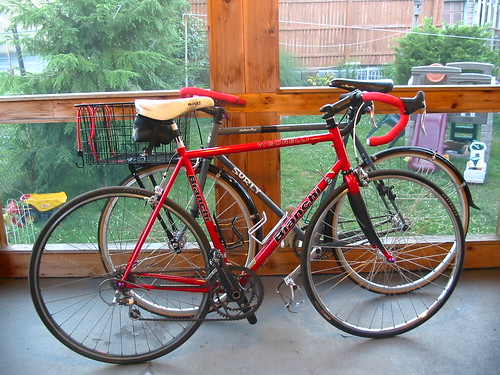
Yin and Yang, originally uploaded by anklebiter_pgh.
Steel frame
Carbon fork
Carbon cranks (!!!!)
Downtube friction shifters
Touring wheels
Having ridden mostly “heavy” bikes for the past few years, I must admit the Vigorelli is good fun for weekend riding. I can put aside my curmudgeonly, Grant Petersen-esque bike opinions for a few hours and blast around on this bike.
Posted on 12 July 2007
By 8:15 am, there were roughly 30 people gathered outside of Tazza d’Oro (which was CLOSED, meaning more than a few folks went without their morning hit of caffeine), waiting for the ride to start. I had, after driving the course the previous weekend, cut the mileage to just a smidge under 50, partially in an effort to accommodate a few folks who wanted to do an alleycat later in the day. The route went north out of the city, along my old commute, into the North Hills, then east, along the Red Belt, to Tarentum, then back along Freeport Road. There were no long hills, but a 10 mile or so section of steep rollers. I had procured a “beater” road bike from Dave–a Bianchi Vigorelli (steel is real!) kitted with touring wheels, Nitto North Road bars, downtube friction shifters and, of all things, carbon cranks. I was excited to have a “light” bike for the hills, as during the IC Populaire, I felt the weight of my old Cannondale was really a hindrance.
Anyway, back to the ride.
The ride drew an eclectic bunch of folks, from lycra-clad roadies to commuters. I left the start a minute or two behind everyone else, riding with Josh. As we rode along Little Pine Creek, we began to gain a bit on a few other folks, and at the top of the hill on Wetzl Road, there was a nice little group together. Wetzl hurt, as expected, but I seemed to recover quickly. The rollers on Mount Royal strung the bunch out a bit, and the hairpin past Duncan really splintered the group. I moved ahead, and pushed relatively hard on the hill coming out of the hairpin, always feeling as if there was someone on my wheel (there wasn’t). When I reached Sample Road, I paused, and waited for a few folks to come into sight, since the turn, though marked, wasn’t terribly obvious. The descent of Sample was good fun (yah! coasting!), and Josh caught up and we took the hard right on Wildwood-Sample Road, a classic country road.
The surface is chipseal, and the road is a rollercoaster of sharp climbs and equally sharp descents. Feeling good on the light bike, I pushed hard on the climbs, and again managed to put some distance between myself and the rest of the group. Though I felt good, I was hoping that I wasn’t burning the wick at both ends. After a short descent, Josh again caught back on, and we picked up Nate, on his swell custom Rivendell. We cruised along together a bit, then caught up with two other folks after a brief navigation error (important note: street names on Google Maps do not necessarily correspond with the real world). The climb on Hardies, heading to Turner Road, splintered the group again, and I moved ahead on the initial descent over rough chipseal. I stayed at the front on the rollers, and we caught another group who were a bit confused about the navigation. A few miles later, together, we turned on the Red Belt.
Slowly, steadily, the bonk approached. I wasn’t having too much trouble staying with the group on the slightly rolling flats of the Red Belt, but my effort was pretty high, with no real opportunity to relax. I could push harder through the rollers because there was always a descent to catch my breath. As we approached Route 28, the group was here, there, everywhere. Once in Tarentum, I caught up with Stuart and Robbie, who were on the side of the road fixing a flat. I thought about saying hello, then pushing on to the next Sheetz, where I could get something to drink and something salty to eat, but, no, I stopped. So went my only hope of finishing with these two. Josh caught us, and we were on our way, but very shortly, Stuart’s rear tire was flat as well. I should have continued on to the Sheetz, but no, I didn’t. After we started again, I officially bonked, and a mile later, I was pulling into the Sheetz. Dummy.
Josh circled back around, and soon enough we were on our way, and I felt considerably better. We caught another group who had flatted, but since they were OK, we didn’t stay for long. 20 minutes later, I was climbing the zoo hill alone (Josh skipped the last hill to head home), and back at Tazza d’Oro. A group of 10 or so riders were milling about, and a few others had already come and gone. Within the next 30 minutes, the bulk of the riders returned, and I was on my way back home. Final distance was close to 50 miles, and comparing Josh and Stuart’s average speeds, I figure I managed about 16mph. Carrying a bit more food, I likely could have stayed with Stuart, but, oh well. It’s not a race, eh?
In the end, 32 people rode, and we managed to donate $160 to Bike Pittsburgh. Not a bad day at all.
Posted on 5 July 2007