First, let’s see how I fared in the results table:
Brian Janaszek : DNS
Did not start? Yup. Oh, I tried. But I failed. Miserably. Thanks to some horrific directions from Google and a lack of a local map, I could not find the start. And when I finally got the directions sorted out, the road I needed to take was closed. Perhaps it was just a sign, that I wasn’t meant to do the ride. Such is life, I suppose. Given the stress of the run-up to this weekend, with the various bike-related issues, it was hugely disappointing to not start.
I could have simply sulked all day, but the weather was fine and the skies were clear, so I took a three and half hour spin through the northern Philadelphia suburbs. It’s hard to stay disappointed when you’ve ridden miles on fine country roads, and you are sitting on the porch of a bakery, sipping coffee in the sunshine. All’s well that ends well.
Posted on 21 October 2006
So I went to the local bike shop last night, rear wheel in hand, to drop it off to get the bearings. Thing is, the kindly mechanic there said “gimme 15 minutes” and sure enough, 15 minutes later, he had the bearings out. Best $12 I’ve spent. Apparently the process involved several screwdrivers, a hammer, and a torch. Yes, torch as in fire. Go figure. This means that I can no longer hide behind mechanical excuses and not ride the Surly this weekend. Oh well, I’ll likely be a better person for it.
Posted on 20 October 2006
Two days ago, it rained quite a bit. On the ride into work, I had to deal with several sections of deep puddles, which absolutely soaked my drivetrain. Now, the bearings in my rear hub were already on their last legs, and this ride did them in completely. I have a spare set of cartridges for the hub, but the current cartridges are absolutely welded into place (and given the construction of the hub–a Miche Primato–there is little room to manuever inside the hub body), and I have been unsuccessful in removing them. This hasn’t been a problem for the commute, as I have a spare wheel, but it throws a wrench into the populaire, as the backup wheel isn’t necessarily something I want to do 100km on. Jen has kindly offered her new rear wheel, but a different cog size means I would need to replace my chainring, and I wouldn’t get the chance to shakedown the new gearing before the event.
Adding to the confusion, I purchased a used Cannondale mountain bike yesterday. With gears and those shifty things. Yes, gears. This has been the plan for some time, as the office will be moving further north and west, and in the interest of getting the commute done faster, I decided to go with some gears. I’ll be putting slick tires on it, and swapping out the bars for something a bit different (likely the Marys from the Steamroller). But now, faced with a limping Steamroller, and a populaire course that is one half climbing and one half descending, I’m tempted to ride the Cannondale. There are, however, obstacles to this as well. First, I need to get the tires (and full fenders) for it. Second, I won’t have the chance to give it a good shakedown before the ride.
What will I do? If it doesn’t rain before my ride home, I may swap out the pedals and ride the Cannondale home, knobbies and all, to give it a test drive. Likely I’ll dawdle on the decision until the moment I have to put a bike on the top of the car for the drive to Philly…
Posted on 19 October 2006
First, a fine post by Daniel Larison on why it might time for conservative Christians to worry a little less about politics and a little more on the life of the Church. I will likely write more about this, but I just wanted to point it out.
Second, an old co-worker asked me yesterday what I thought about this situation. Well, honestly, my first reaction is that most celebrities are a few beans shy of a burrito, and that something like this is, at least in part, a grab at attention. That, however, does not get at the crux of the issue–intercultural adoption. First, I’ll say I don’t have any well-formulated (or even poorly-formulated) theories about this. But such activities worry me for several reason. There is a conceit among Westerners that our culture is the pinnacle of achievement, and therefore anyone living in a different culture is somehow “less fortunate.” Now, I do not deny that in many African nations, the combination of the AIDS epidemic, famine, and unstable politics have put the populations in situations where their basic needs cannot be met. This does not, however, justify simply plucking children out of the situation, as it does little to get at the root causes of the problems. Yes, it is good that at least one child is rescued from a (potentially) hopeless situation, but what of the one hundred others who aren’t? And, perhaps more importantly, what of the children in orphanages in your own town? Is there something about their plight that is somehow “better” than that of the children in Africa?
So am I ready to declare that anyone who has adopted a foreign-born child as Bad or Wrong? No. To each their own. I might ask them, however, why they didn’t chose to adopt from the agency in their town. Of course, perhaps they did, and they were unsuccessful. That happens, I suppose. But the latest cause celebre among the beautiful people (“let’s save Africa by adopting all the kids”) is problematic, primarily because it does little the solve the real problems there (and it might be noted that perhaps westerners have little business mucking about in the problems of other nations–Ivan Illich was notoriously against such efforts).
Posted on 18 October 2006
People often ask me if there are days that I wish I didn’t have to ride my bike to work. A few, I say. Most of the questions begin in the Fall, when the temperatures begin to dip into the 30s at night. I don’t mind the cold, I say. In fact, I’ll take 30 degrees and sunny any day of the year. It’s the rain that I don’t enjoy. And this morning, as the drops hammer the windows (and green and yellow fill the regional radar), I’m less than motivated to hit the road. What’s odd, however, is that I seem to ride better in this weather. Perhaps the rain takes my mind off the effort.
Posted on 17 October 2006
The cuesheets and profile maps have been released for the populaire and brevet next weekend in Eastern Pennsylvania. I’m mildly relieved looking at the map for the 100km populaire, as there is really only one long climb roughly halfway through the ride. What’s shocking, however, is a little stat at the bottom of the profile map. Total climbing mileage is 32. Total descending mileage is 31. Based on my calculations, that means in the course of a 64 mile route, there will be only a single mile of flat roads. At least my rolling commute has been good training.
Posted on 15 October 2006
I have been working on a dialogue with Dr. Koyzis for an upcoming issue of Comment about our perspectives on Jacques Ellul. This is a re-write of my initial response to Koyzis’ essay which will not appear in Comment. No need for it languish on my computer.
Jacques Ellul has always been a difficult nut to crack. His vast body of work, which covers sociology, technology, theology, and philosophy, often seems at odds with itself, a product of the dialectical methods Ellul used. Add to this his on again, off again relationship with Calvinism (he was a member of the French reformed church, yet often critiqued Calvinism and embraced Barthian thought, all the while displaying a rather Calvinist sense of humanity and God’s grace), and it is difficult to grasp the perspective from which Ellul writes. Often, one must take Ellul with a grain of salt, realizing the man was not always attempting to construct a framework of thought or theology, instead analyzing a given area of thought and critiquing particular aspects of it. David Koyzis, wearing his Dutch-tinted glasses, examines Ellul’s “Technique and the Opening Chapters of Genesis,” Ellul’s essay on the place of Technique in the Created Order, and comes away unimpressed with Ellul’s conclusions. Because Ellul rejects technology and institutions as part of the Created Order (they are, rather, methods with which we deal with the effects of the Fall), Koyzis sees no compelling reason for Ellul (or an Ellulian, if such a person exists) to embrace the Cultural Mandate or even seek to redirect activities in this world back toward God. Essentially, Ellul leaves us hopelessly adrift in this world, separated from God and unable to change things for the better.
Dr. Koyzis outlines three basic problems with Ellul’s view of creation before and after the Fall. On one point, I am in agreement–that Ellul’s vision of the Created Order is rather suspect (as any Calvinist should be). On his third point, however, I must disagree. Koyzis says:
Third, if Ellul is correct in his view of creation and sin, then it is not clear how we can go about living the Christian life, either as individuals or as communities. Given that the fall into sin introduced something ontic and unprecedented into creation?and not merely its misdirection in the Augustinian sense?redemption cannot be the restoration of that creation. It does not reorient the totality of our life in this world in an obedient direction, because, as Yoder puts it, “we have no access to the good creation of God” this side of the fall into sin. It is structurally impossible for us to live in accordance with the pristine wholeness of the original creation, because it no longer exists. All that remains for us is to fall back on the Bible as the sole source of direction for our “spiritual lives” while grudgingly accepting?what else can we do??the imperatives of the larger world in so-called secular life…
Indeed, in this particular essay, Ellul gives little direction for a life of Christian action. But just as we do not dismiss Abraham Kuyper because of his racist remarks, nor should we dismiss Ellul because of his view of Eden. In fact, one does not need to look much further than Ellul’s biography for a vision of the Christian life on Earth–his work spanned programs for “troubled” youth to ecological activism focused on the French seacoast. His theological insights hardly prevented him from a life of action focused on the redemptive work of Christ. A better outline of Ellul’s “vision” for a life of Christian action can be found in his book Presence of the Kingdom, an examination of how a Christian should live in this present age. This vision is founded on the action of the Church (that is, the body of Christ), which Ellul says stands at the point where God and the world meet. God calls the Christian to stand ready, with a supple heart, listening always for the direction of Christ.
Koyzis continues this line of thought by questioning whether Ellul’s influence would motivate Christians to engage in “cultural transformative” activities and seeking to restore institutions like the State, the educational system, and the family. This is a loaded question. First, it assumes that particular institutions were a part of the created order, and second, it assumes that Ellul believes that we have no hope of bringing Christ’s redemptive work into this world. As for bringing Christ’s redemptive work into the world, again, this is the point of the Presence of the Kingdom. Ellul is skeptical of many institutions (particularly the State), but he would not deny that those institutions could do the work of Christ. His desire is for a life of Christian action, always ready to listen to the guidance of our God. This means, of course, that one could be called to a life of service in the government, or a labor union. But what of the place of institutions in the created order? Koyzis assumes that governments, labor unions, and schools (for example) would have developed even without the Fall. If unions exist to protect the rights of workers, what would they do in a world without sin? And what of the government? Yes, the role of the State extends beyond simply the legislation and execution of law–it provides for the infrastructure of its citzens–and we can imagine the State still doing its work without the Fall. Yet we can also imagine the State being unnecessary without the effects of sin, as communities and individuals, unblemished as they would be, working together to provide for each other.
One final note: Koyzis is troubled by the “discontinuity” of the created order and its post-fall manifestation. The analogy often used is this: for the Calvinist (often Neo- or not) creation can be seen has a mirror of God. The Fall, however, has titled the mirror away from God and focused it on something else. This leaves us with the ability to slowly tilted the mirror back to God and reflect His full glory. For Ellul, the Fall has cracked the mirror, and only God can repair it. Therefore, we must attempt to work around the damage to see God for who He is. As a result, Technique and the various institutions we have created are necessarily sinful, but they are our response to the Fallen world, and therefore those efforts may often fall short of what God truly desires for us. This warning is worth considering. Technique, as much as it has bettered our lives, may not be what God has intended for us. Yes, the Cultural Mandate has commanded us to draw potentialities out of Creation, but not every development is necessarily one that draws us closer to our Creator.
Posted on 12 October 2006
Rod Dreher examines how his “Crunchy Con” neo-traditionalism may in fact be just another consumer choice in this modern world. Dreher shares two critiques of his sensibility, one from a theologian and another from Maggie Gallagher, both of whom are unconvinced that buying into a tradition that is not your own is a solution to the problems of modernity.
There is some merit to the critiques, and, in a sense, I agree with them. Dreher wonders what other solution there might be, and for that question I offer this bit of advice from Fr. Jape:
This is nothing less than the key to the pursuit of Christian holiness, which is the whole of the Christian adventure: live in love with the frailty and limits of one?s existence, suffering the places, customs, rites, joys, and sorrows of the people who are in close relation to you by family, friendship, and community?all in service of the truth, goodness, and beauty that is best experienced directly. The discipline of place teaches that it is more than enough to care skillfully and lovingly for one?s own little circle, and this is the model for the good life, not the limitless jurisdiction of the ego, granted by a doctrine of choice, that is ever seeking its own fulfillment, pleasure, and satiation. The Puritan heritage of America has long chafed against this discipline as it necessarily limits one to a small field of action in a world with seemingly little hope for eschatological fulfillment. Thus have American Evangelicals historically pined after their great mission of ?giftedness? and ?calling,? forsaking that foolishness of the Gospel of our Lord which has ever lain at their doorstep, in need of nurturing care.
One need not be a part of a tradition to follow this advice. In fact, I think we are moving toward a time when our culture will be rootless, as a generation of children who came of age in the flight to the suburbs raise their own children. It can simply to be enough to settle somewhere, care for one’s family and that place, and pass that life on to one’s children.
Posted on 11 October 2006
I tried out a few of the Carradice mounting hacks last night and rode to work with the saddlebag this morning. Full pictures will be forthcoming, but I used a longer toe strap and a section of PVC pipe mounted to the seat tube to push the bag back a bit, away from my thighs, and I affixed a short piece of dowel into the rails of my saddle to take the place of proper saddlebag loops. I also jammed two sections of dowel inside the bag to support the PVC pipe and keep the rear of bag off the tire.
So how did work? Well, I didn’t clamp the dowel to the saddle rails, so as you might expect, it slid a bit. Not enough for the saddlebag loops to slip off, but this was annoying nonetheless. Tape or a small clamp should fix that. The PVC pipe worked well and didn’t slip at all. I still had to attach the rear fender to keep the bottom of the bag off the tire, however, though I couldn’t find a piece of plastic sheeting to lay inside the bag to give it shape when it carried my tool kit and pump. I will probably attempt to tweak the setup a bit tonight, but I sense I may punt before the populaire and purchase a cheap seatpost-mounted rack to support the bag.
Posted on 10 October 2006
Keith asked for it, so here it is: the evolution of the Steamroller.
The bike started as a stripped down hipster track bike. This is right after the initial build:
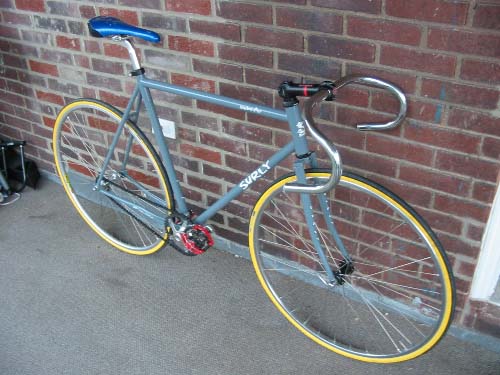
It stayed this way for roughly a year or so, with a few slight variations. I rode bullhorns periodically, got a new wheelset (Miche Primato hubs with Mavic MA-3 rims), put keirin grips on the bars, and rode with clips and straps rather than the clipless pedals. Then a new job and hilly commute to the suburbs meant the bike needed to change a bit to better suit the terrain. So, a bar and stem swap got it here:
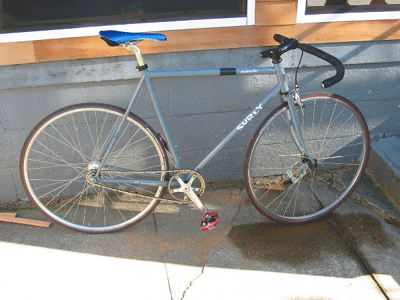
This lasted for nearly a year, until I decided I could quite tweak the fit of the Midge bars properly thanks to a too-short steerer tube. So, thanks to the magic of the interweb, I promptly found someone willing to trade for a set of Marys:
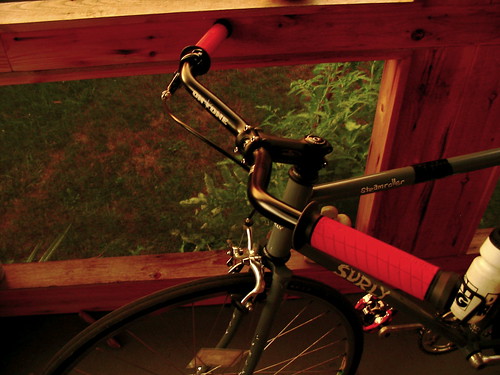
My growing interest in randonneuring has lead to another tweak or two, namely the addition of a Carradice saddlebag:
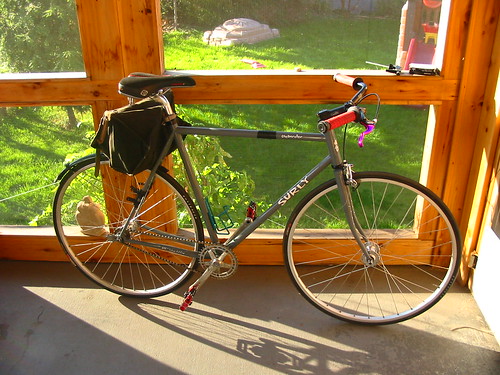
With a full rando/touring bike on my horizon, I doubt I’ll make many more changes to the Steamroller. In fact, once I get a new bike, the Carradice will probably move there. I’ve considered re-kitting the Steamroller as an urban track bike again, but the current setup is, frankly, just too comfy.
Posted on 9 October 2006