I’m not sure why I didn’t think to look before, but I found a bag dedicated to Carradice mounting hacks.
Posted on 9 October 2006
I’m not sure why I didn’t think to look before, but I found a bag dedicated to Carradice mounting hacks.
Posted on 9 October 2006
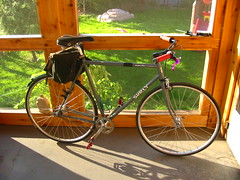 Today was supposed to a long ride north, in preparation for the populaire in a few weeks. I hoped to do 30 or 40 miles, testing out the new rando setup and feeling out the hill climbing abilities of the Steamroller’s new gearing. This was not, hoever, to be. About two miles out, cresting a short rise out of Sharpsburg, my tough-as-iron Bontrager Hard Case rear tire got a flat. Now, after nearly 4000 miles without a flat, this was to be expected, I supposed. The rear tire was riddled with cuts, and even though these days I rarely skid or skip-stop, the rubber was running thin. I pulled off the road and promptly changed the tube. Then I considered my options. I didn’t have another tube or a patch kit, so I was facing another 30 miles without a safety. I turned around and grudgingly rode home.
Several hours later, and I’ve attached my head light, and I’m heading out in the dying evening night for a short ride before the kids go to bed. I decided the forgo the (dark) ride out into the suburbs, instead enjoying mostly empty roads by heading downtown through the Strip District. I rode up the Jail Trail, enjoying the relatively still air and pushing a decent pace, crossed the Hot Metal Bridge, then looped through the South Side and back up through Oakland, and home.
Yes, it wasn’t the length I expected, but it did give me a good chance to feel out the setup for the new (used) Carradice saddlebag. I do need to fiddle with the mounting system a bit, as it hangs a bit low and a bit too far forward. It was a bit odd at first climbing out of the saddle with bag on, especially with my headlight battery back there too. But, it was good to ride with my full repair kit, a pump, a shell, wallet, phone, and a bit of food without everything on my back in the messenger bag.
Related–this bike is quite nice.
Posted on 8 October 2006
From chapter four of Presence of the Kingdom:
It is only in Jesus Christ that we have any possibility of understanding this wild adventure on which we have started, for in the midst of these shadows He is there, the Person, the Event, in the midst of these whirlwinds of facts, the Author and Finisher of our faith.
Posted on 5 October 2006
I was talking to David today via email about commuting bicycles. He had just returned from Italy, and noted that the typical bicycle there was kitted for practical commuting–comfy saddles and handlebars, upright riding positions, panniers, etc. And he said he was thinking about following suit. I couldn’t agree more. The commute over the past year has forced to re-think what makes a good (read: useful) commuting bicycle. When I started, the Steamroller was equipped with track drops and clips and straps, and was brakeless. Quickly, I added clipless pedals (for the hills) and flared drops for easier climbing. While the flared drops were fantastic bars, due to a too-short steerer on the fork, I couldn’t find a stem with enough rise to make the bars comfortable for extended rides. So off they went, and in came the Marys, which I’m still very happily running. The gearing has crept down again, back to 39×16, a happy medium between the easier spinning/get nowhere fast 42×18 and the nice city gear of 45×18.
And now, with a potentially longer commute and a blossoming interested in randonneuring, I’m considering a geared bike. At first, I thought I’d go with either what I could find used (likely a mountain bike converted for road use) or an inexpensive hybrid (like the Kona Dew). And of course, there is the dream bike, the Kogswell P/R. But I’ve settled on finding something a bit more unique, in the character of the Bridgestone bikes of the late 80s and early 90s–incredibly goofy, practical, comfortable machines, built for practicality rather than speed (for what it’s worth, this design mentality came to its pinnacle in the 1993 XO-1). Will I manage to find a Bridgestone? Not likely. But the early 90s Panasonic road frame in our basement might make for a good clone.
Posted on 2 October 2006
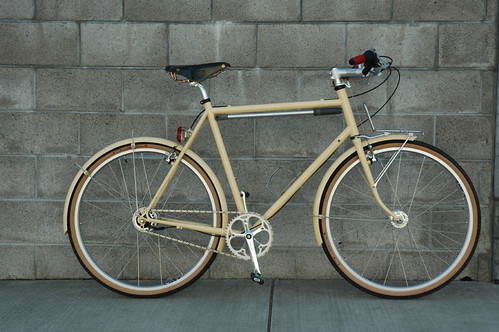
This is my dream Porteur–Mary bars, Nexus 7 speed hub, smaller front rack. All it needs is a dynohub/front light combo.
Posted on 27 September 2006
Kogswell has officially released its Porteur/Randonneur into production. ‘Tis pretty:

Very nice, though I might prefer it with some weird Nitto bars instead of the drops. Additionally, Rivendell has released the Bleriot, a more cost-friendly version of their Saluki 650B/Porteur model.
And, after switching the gearing on the Surly a few times this week, I’ve settled back into running 39×16, the first combination I ran when I started riding a fixed gear. With the hilly populaire looming, I wanted to settle on a gear that wouldn’t destroy my knees on the climbs, yet still provide a reasonable amount of speed on the flats and descents. It’s also a nice gear for the commute, since it is a touch taller than my old 42×18 fallback gearing.
Posted on 27 September 2006
After a near miss and bent rim in the last race, I decided to approach this event as a nice day riding around the city. No need to risk life and limb. Enjoy the weather.
Yeah, right.
The race was a poker run: five checkpoints, at each of which you would be given a playing card. At the finish, you would play your hand (given one chance to swap cards). Points were given to order of finish and to your poker hand. Most points won. Oh, and there was a catch–some of the checkpoints would require something of you to get the card. The checkpoints were:
* The North Side trail, under the West End Bridge.
* Friendship Park.
* Mellon Park.
* Flagstaff Hill.
* REI, South Side
The race started in Armstrong Park, South Side. The consensus among those gathered was the clockwise loop (in the order listed above) was superior to the counter-clockwise loop, which likely require a climb up Bates Street. This was mistake number one. After I had decided on this route, I thought I could cut a bit of distance off the end of the ride by using the trail system in Schenley to promptly get to the South Side. Never once did it occur to me that I could use this same trail system to avoid the Bates climb. Oh well. This is how my little brain work sometimes, I suppose.
We were off. Traffic was thick on Carson Street, and the combination of my timidness and my wide handlebars had me second guessing the gaps between cars. I missed the green light at 10th Street, and I was already a block behind. As we approached the Smithfield Street Bridge, I noted that the pack was chosing to use the West End Bridge. No thanks–I don’t particularly like that span in the car. So I crossed the Smithfield Street Bridge, cut through town, and across the pedestrian walkway on the Fort Duquesne Bridge, and caught the North Side trail between the stadia.
Bad idea #2.
Thanks to a Pitt game, the sidewalks and trail were teeming with people, thus considerably slowing my progress. Once I had my card, I cut throught the Science Center parking lot and worked my way back to town on the street rather than dealing with the crowds on the trail again. Once through town, I was on Smallman Street and spied two racers roughly two blocks ahead of me. Both of them were on geared bikes, so I pedaled furiously to keep pace, with the intention of making up ground on the grind up Penn. As we approached Penn I formulated my plan for the hill. I was tired–there had been a solid headwind through most of the ride, and it was considerably worse in the Strip. I didn’t have enough water either. But, knowing how Penn typically feels, I knew I could probably ride my own pace and at least close the gap. Then again, knowing how Penn feels, I decided to push the pace a bit.
As I zig-zagged from Smallman to Penn, I noticed the group (now three) had already broken up a bit on the initial rise. It was then that an old feeling, one from the day’s of soccer camp two-a-days and cross country running, came over me. It’s a creeping dread about the task at hand, one that will require you dig a bit deeper and hurt just a little more. I wanted to jump out of the saddle and mash away to catch them, but I stopped myself and settled into a smoother rhythm. Within another block I had closed the gap on the last of the three, and within another block I passed her. We exchanged pleasantries and stood up to slip back to the right along the line of parked cars. Number two was another block or so ahead.
At this point I probably bonked a bit. Not a full blown, hitting-the-wall thing, more of a wow-this-hurts-a-lot thing. I pulled up to the rear wheel of the second rider, and we both paused at the red light at 40th Street. I pulled away on green, realizing that the first rider had made the green light and was a few blocks ahead by now. It was no use trying to make up that ground now. I approach Friendship Park and see a group of racers zoom in front of me. Why aren’t they just cutting across the park? I think. Then I find the answer. In order to get the card for the checkpoint, you are required to take a Champs d’Elysees -style lap around the oval. A minute later I pocket my card and heard for Mellon Park.
This checkpoint, and the ride to Flagstaff were uneventful. Then things went wrong. After collecting my card at Flagstaff, I slipped behind Phipps and to the trail that leads to Panther Hollow, and eventually the Jail Trail. Unfortunately, this trail was closed. So I backtracked, and instead of changing my plan and blasting down Bates, I descended the stairs into Panther Hollow.
Bad idea #3.
Bouncing on the rough trail to the lake, I could at least take solace in the fact that my front wheel build seemed to be handling the pounding quite well. Then, finally, I was on 2nd Avenue, ready to cross the Hot Metal Bridge and collect my last card at the REI in the South Side Works. Approaching Armstrong Park via Carson, another racer, who had flatted on Penn caught me, further impressing upon the error of my ways. We got to the park together, finishing just outside the top ten. Oh, and those folks I passed on Penn? They had just beat me back. Yes, bad navigation was my undoing again.
Thanks to a decent poker hand (two pair) I squeezed into the top ten overall. Lucky.
Posted on 24 September 2006
The New Pantagruel has shuttered its windows. I have greatly appreciated the work of my former classmate Caleb Stegall and new acquintance Dan Knauss (and the rest of their co-conspirators), and their articulated philosophy has informed, in part, our lifestyle. I am very grateful that, for a time, my name was associated with the project as their web lackey. It is worth reprinting their parting words here:
After a three year run, The New Pantagruel is closing shop. Our incursion was never intended to be a long one. We are not careerists and had no intention or ambition to become part of the media establishment, Christian or otherwise. We did wish to demonstrate that such populist anti-liberal incursions were possible, and occasionally desirable. Against a chorus of establishment naysayers, The New Pantagruel succeeded on a shoestring budget and without any insider access in garnering national attention and influence, particularly within the elite Christian press and some political outlets. Our voice was primarily a voice of dissent, and it has been heartening to know that such voices can still capture the spirit of a large number of diffuse people and perspectives in today?s managed climate of ?centrist? opinion.
Ours can largely be summed up as a localist, decentralist, anarcho-Christian and authentically conservative approach to politics and culture. As we have written previously, we believe that to suffer one?s place and one?s people in the particularity of its and their needs is the only true basis for finding love, friendship, and an authentic, meaningful life. This is nothing less than the key to the pursuit of Christian holiness, which is the whole of the Christian adventure: to live in love with the frailty and limits of one?s existence, suffering the places, customs, rites, joys, and sorrows of the people who are in close relation to you by family, friendship, and community–all in service of the truth, goodness, and beauty that is best experienced directly. The discipline of place teaches that it is more than enough to care skillfully and lovingly for one?s own little circle, and this is the model for the good life, not the limitless jurisdiction of the ego, granted by a doctrine of choice, that is ever seeking its own fulfillment, pleasure, and satiation.
Taking that charge seriously, The New Pantagruel has, essentially, argued itself out of existence. This is a good thing. In the end, we are pessimistic romantics. We believe life is eucatastrophic: a joyous catastrophe. Instead of spending endless hours before the faceless void of the ?new media,? we will be engaging the tragedies and necessities of raising families, rebuilding neighborhoods and small towns, and fighting to preserve and save that which we love. As we dive back into the particularities of our places and people and their needs, we hope you will do the same. And remember, Fr. Jape is watching you.
Posted on 22 September 2006
After speaking with a few folks via the NJ Randonneurs message board, I’ve decided that I will most certainly ride the Surly for the Eastern PA Populaire next month. I waivered a bit, given the lay of the land, but several riders noted that as long as I wasn’t afraid to walk my bike up the worst of the climbs, I wouldn’t have any problems finishing within the time limit. I’m not sure how much “training” I’ll do for the event besides a few longer (50 mile-ish) rides. The biggest question now is gearing–do I still with my current 45×18, size up an inch or two to 42×16, or play it safe with 42×18? None of those choices will get up the worst of the hills (the Saucon Valley climbs–and remember, I’ll be heading back after 30 miles or so, since the elevation map is for the 200k brevet), so it be best to run 42×16 to provide a bit more speed on the shorter climbs and descents.
Posted on 15 September 2006
First, at Caelum et Terra, Daniel Nichols examines the difference between policy and theology/philosophy, and why Christians really only have a single choice in such matters.
Second, Fr. Neuhaus discusses the often rocky relationship between faith and reason and how, perhaps, Christians should approach mending that relationship.
Posted on 14 September 2006
